It’s difficult to wrap our minds around how European fire brigade integrate sport into their budgets. It’s not like here where everything that rings of “sport” is an arms-length relationship. You may have watched some of the events in which firefighters participate in on YouTube.
While in Kiev, the firefighters put on a demonstration for me. A video compendium can be viewed on our Vimeo account here:
Kiev Firefighters participating in sports events
Over the next several postings, I’ll be providing narrative and photos of the sights and activities from Ukraine, including the visit to Chernobyl.

Timely thoughts and relevant information for fire-athletes...©, 2023
Tuesday, May 15, 2018

Sunday, May 6, 2018
More Ukrainian Emergency Services info
We’ve visited several of the fire stations in Ukraine, including HQ and the Training Academy. They have a maze-smoke building and an incredible gym that includes a four-lane track, pool, basketball-volleyball court.
My wife got a shot at the Jaws of Life and cut a piece of rebar. Debbie wielding the Jaws of LIfe at the Kiev FD
 |
| Firefighters and their families live in this apartment building above the apparatus bay |
 |
| There are four lanes for sprinting in the obstacle course where a ladder might be carried and a balance beam transversed. |
Saturday, May 5, 2018
The Kiev, Ukraine Fire Service
I’m sharing with you some of the highlights from my visit to several of the fire stations in Kiev, the capital of Ukraine.
 |
| The newest piece of apparatus is a Ford engine |
 |
| Kiev is a city of more than 3.5M and a fire service of approximately 3500. There are over 25 stations. Julia, wife of Special Operations Chief served as our translator. |
Thursday, May 3, 2018
Dateline: Kiev Ukraine
Travels this week take us to the capital of Ukraine, where discussions surrounding the implementation of the Firefighter Combat Challenge are taking place. Photos tell the story better than words.
We’ll continue to post more photos and narrative as the week continues. Looking for some North American competitors that would be interested in coming to Ukraine.
 |
| View from the tower of the Headquarters Station in Kiev, Ukraine |
 |
| Meeting with the Chief of Department and review of video of Challenge site |
Monday, April 2, 2018
Exercise can slow the ageing process – a professor explains how
Professor of Immune Cell Biology, University of Birmingham
The tradition of sending a telegram to every British citizen on their 100th birthday was started just over 100 years ago by George V, who sent out just nine letters. Last year, the Queen had to sign over 16,000 birthday letters. The UK has an aging society, with falling birth rates and increasing life expectancy. Improvements in public health and medicine have helped to achieve this amazing effect on lifespan.
But for far too many, old age is endured and not enjoyed, being associated with disease and physical and mental frailty. Today’s baby boomers may be less likely than previous generations to accept that old age is a time for taking it easy, getting to know your GP and developing a taste for the settee, slippers and daytime TV.
My latest research project, conducted with colleagues at the University of Birmingham and Professor Stephen Harridge at King’s College London, aims to understand which aspects of human aging are inevitable, and which are a result of our modern lifestyles – and therefore under our control.
Staying strong
Prehistoric hunter-gatherer tribes were highly active, spending a lot of time and energy sourcing their food. If they weren’t successful, they would also spend days with or little or no food. By contrast, today we are a highly sedentary society; one study by the Heart Foundation revealed that most adults spend 15 hours a day sitting down. Together with eight hours of sleep, this leaves just one hour for physical activity.

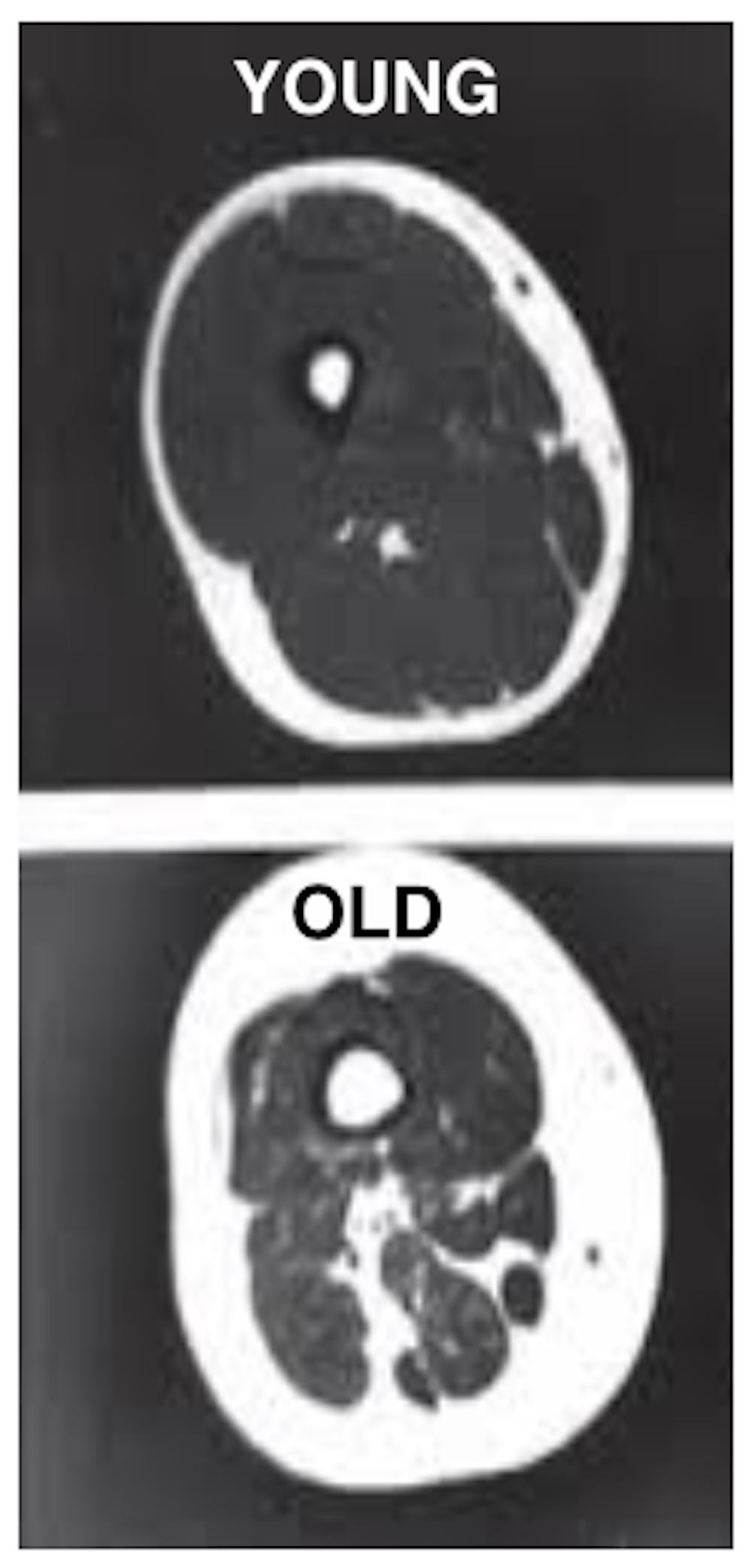 An MRI scan of the thigh: as people age, muscle mass declines and turns to fat. Janet Lord/University of Birmingham., Author provided
As we get older, our physical activity levels decline even further. In our research, we have tried to determine how much this low level of physical activity contributes to the aging of many body systems, including muscle, bone and the immune system.
We examined 125 male and female cyclists, aged 55 to 79, who had maintained a high level of cycling throughout most of their adult lives. These were not Olympians, but very keen cyclists who were able to cycle 100km in under 6.5 hours for the men, and 60km in under 5.5 hours for the women.
We have previously looked at several body systems that we know decline with age, such as muscle and bone. At mid-life, people start losing muscle mass and strength at a rate of 1% to 2% per year, making it harder to carry out their normal activities such as climbing stairs. Our bones also become thinner with age and this can eventually lead to diseases such as osteoporosis.
We showed that the cyclists did not lose muscle mass or strength as they age, and their bones only became slightly thinner. We then went on to examine a body system that was not so obviously influenced by physical activity – the immune system.
Start ‘em young
The immune system declines with age, making older adults more susceptible to infections such as flu and pneumonia. They also respond less well to vaccines, so this preventive measure doesn’t offer the same protection which it can to younger people. When we compared the immune system of the cyclists to older adults who had not done regular exercise, and to young people in their twenties we found that their immune systems looked most like the young persons’.
In particular, we found that the cyclists still made lots of new immune T cells, produced by an organ called the thymus, which normally starts to shrink after we reach puberty. The older cyclists seemed to have a thymus that was making as many new T cells as the young people’s. The lifelong cycling seemed to have slowed down the aging of their immune systems.
 The thymus shrinks with age, affecting immune system function. Janet Lord/University of Birmingham, Author provided
We investigated why this happened and found that the cyclists had high levels of a hormone called interleukin 7 in their blood, which helps to stop the thymus shrinking. Interleukin 7 is made by many cells in the body, including muscle cells, so we think that active muscles will make more of this hormone and keep the immune system, and especially the thymus, young.
So it is possible to take back control of your body and prevent its deterioration with age. The UK’s chief medical officer Sally Davies suggests that people do at least 150 minutes of aerobic exercise per week. We don’t know if this is enough to protect your immune system, but it’s a good place to start.
Our physical activity levels start to decline from the age of 25 in the UK, so don’t leave exercise until old age – start now.
Monday, March 19, 2018
How exercise in old age prevents the immune system from declining
Fergus Walsh, Medical Correspondent, BBC
Doing lots of exercise in older age can prevent the immune system from declining and protect people against infections, scientists say.
They followed 125 long-distance cyclists, some now in their 80s, and found they had the immune systems of 20-year-olds.
Prof Norman Lazarus, 82, of King's College London, who took part in and co-authored the research, said: "If exercise was a pill, everyone would be taking it.
"It has wide-ranging benefits for the body, the mind, for our muscles and our immune system."
The research was published in the journal Aging Cell.
Prof Janet Lord, director of the Institute of Inflammation and Ageing, at the University of Birmingham, and co-author of the research, said: "The immune system declines by about 2-3% a year from our 20s, which is why older people are more susceptible to infections, conditions like rheumatoid arthritis and, potentially, cancer.
"Because the cyclists have the immune system of a 20-year-old rather than a 70- or 80-year-old, it means they have added protection against all these issues."
The researchers looked at markers in the blood for T-cells, which help the immune system respond to new infections.
These are produced in the thymus, a gland in the chest, which normally shrinks in size in adulthood.
Out of puff
They found that the endurance cyclists were producing the same level of T-cells as adults in their 20s, whereas a group of inactive older adults were producing very few.
The researchers believe that being physically active in old age will help people respond better to vaccines, and so be better protected against infections such as flu.
Steve Harridge, co-author and professor of physiology at King's College London, said: "Being sedentary goes against evolution because humans are designed to be physically active.
One elderly cyclist said he had the body fat of a 19-year-old
"You don't need to be a competitive athlete to reap the benefits - or be an endurance cyclist - anything which gets you moving and a little bit out of puff will help."
Prof Harridge and Prof Lazarus believe that highly physically active older people represent the perfect group in which to analyze the true effects of biological ageing.
A separate paper in Aging Cell found that the cyclists did not lose muscle mass or strength, and did not see an increase in body fat - which are usually associated with ageing.
I met a dozen of the cyclists, on a morning ride in Surrey. Despite the bitter cold, they were universally cheerful, and clearly used to riding in all weathers.
They are members of Audax, a long-distance cycling organization that organizes events ranging from 100km to 300km.
The older members - in their 80s - say they do only the "short" 100km (62-mile) rides, but this is still highly impressive.
So why do they do it?
Pam Jones, 79, told me: "I do it for my health, because it's sociable, and because I enjoy the freedom it gives you."
Brian Matkins, 82, said: "One of the first results I got from the medical study was I was told my body fat was comparable to that of a 19-year-old."
Aged just 64, Jim Woods, is a comparative youngster in the group. He averages 100 miles a week on his bike, with more during the summer.
He said: "I cycle for a sense of wellbeing and to enjoy our wonderful countryside."
Cycling 60 miles or more may not be your idea of fun, but these riders have found something that gives them pleasure, which is a key reason why they continue.
Doing lots of exercise in older age can prevent the immune system from declining and protect people against infections, scientists say.
They followed 125 long-distance cyclists, some now in their 80s, and found they had the immune systems of 20-year-olds.
Prof Norman Lazarus, 82, of King's College London, who took part in and co-authored the research, said: "If exercise was a pill, everyone would be taking it.
"It has wide-ranging benefits for the body, the mind, for our muscles and our immune system."
The research was published in the journal Aging Cell.
Prof Janet Lord, director of the Institute of Inflammation and Ageing, at the University of Birmingham, and co-author of the research, said: "The immune system declines by about 2-3% a year from our 20s, which is why older people are more susceptible to infections, conditions like rheumatoid arthritis and, potentially, cancer.
"Because the cyclists have the immune system of a 20-year-old rather than a 70- or 80-year-old, it means they have added protection against all these issues."
The researchers looked at markers in the blood for T-cells, which help the immune system respond to new infections.
These are produced in the thymus, a gland in the chest, which normally shrinks in size in adulthood.
Out of puff
They found that the endurance cyclists were producing the same level of T-cells as adults in their 20s, whereas a group of inactive older adults were producing very few.
The researchers believe that being physically active in old age will help people respond better to vaccines, and so be better protected against infections such as flu.
Steve Harridge, co-author and professor of physiology at King's College London, said: "Being sedentary goes against evolution because humans are designed to be physically active.
One elderly cyclist said he had the body fat of a 19-year-old
"You don't need to be a competitive athlete to reap the benefits - or be an endurance cyclist - anything which gets you moving and a little bit out of puff will help."
Prof Harridge and Prof Lazarus believe that highly physically active older people represent the perfect group in which to analyze the true effects of biological ageing.
A separate paper in Aging Cell found that the cyclists did not lose muscle mass or strength, and did not see an increase in body fat - which are usually associated with ageing.
I met a dozen of the cyclists, on a morning ride in Surrey. Despite the bitter cold, they were universally cheerful, and clearly used to riding in all weathers.
They are members of Audax, a long-distance cycling organization that organizes events ranging from 100km to 300km.
The older members - in their 80s - say they do only the "short" 100km (62-mile) rides, but this is still highly impressive.
So why do they do it?
Pam Jones, 79, told me: "I do it for my health, because it's sociable, and because I enjoy the freedom it gives you."
Brian Matkins, 82, said: "One of the first results I got from the medical study was I was told my body fat was comparable to that of a 19-year-old."
Aged just 64, Jim Woods, is a comparative youngster in the group. He averages 100 miles a week on his bike, with more during the summer.
He said: "I cycle for a sense of wellbeing and to enjoy our wonderful countryside."
Cycling 60 miles or more may not be your idea of fun, but these riders have found something that gives them pleasure, which is a key reason why they continue.
Monday, March 5, 2018
What is the Most Accurate Predictor of Early Death?
Let us ask you perhaps the biggest question in the medical world:
What’s the most accurate predictor of early death?
If you’re not sure - you’re not alone...
Because for decades, this “longevity question” has stumped top labs across the country, leading many in the science community to call this the “holy grail” of our research... but thanks to an incredible new study, it turns out the “true indicator” of a long, healthy life may have finally been cracked.
Because your REAL age might be predicted inside your cells. You see, researchers at Ohio State University conducted a wide-scale human study on a very specific biological marker inside all of us -
They’re called telomeres.
Telomeres are the genetic “caps” on your DNA, responsible for holding together the entire blueprint of you. Think of telomeres like the plastic cap on a shoelace. Over time, as the cap becomes frayed, that shoelace begins to unravel.
Well, your telomeres work the same way - only as they wear down, it’s your DNA that begins to unravel. And when your DNA begins to unravel, you can experience declining health and rapid aging.
What’s the most accurate predictor of early death?
If you’re not sure - you’re not alone...
Because for decades, this “longevity question” has stumped top labs across the country, leading many in the science community to call this the “holy grail” of our research... but thanks to an incredible new study, it turns out the “true indicator” of a long, healthy life may have finally been cracked.
Because your REAL age might be predicted inside your cells. You see, researchers at Ohio State University conducted a wide-scale human study on a very specific biological marker inside all of us -
They’re called telomeres.
Telomeres are the genetic “caps” on your DNA, responsible for holding together the entire blueprint of you. Think of telomeres like the plastic cap on a shoelace. Over time, as the cap becomes frayed, that shoelace begins to unravel.
Well, your telomeres work the same way - only as they wear down, it’s your DNA that begins to unravel. And when your DNA begins to unravel, you can experience declining health and rapid aging.
So with this in mind, the researchers tested people of similar age and gender... but with varying degrees of health. And amazingly, they discovered that although all his test subjects were the same age - there was actually one MAJOR difference inside them:
The group with worse health had SIGNIFICANTLY shorter telomeres. 1.
And some scientists believe the main culprit of shorter telomeres was “cellular stress.”
This is VERY important. Because when left unchecked, this stress could eat away at your telomeres, leading to:
• Excess weight gain
• Low energy
• Sore muscles and achy joints
• And worst of all, perhaps vastly reduced longevity...
In fact, the people in this study with the most cellular stress had literally aged 9 years more than their counterparts on the cellular level... even though they were the exact same age.2
Which is why you’ve probably noticed how some people in their 80s look perfectly healthy, while others as young as 40 can already seem so old...
It’s not necessarily the number of years you’ve been alive that determines your healthy lifespan... Some of it is actually the amount of cellular stress inside you.
Sources:
1. Damjanovic AK, Yang Y, Glaser R et al. Accelerated telomere erosion is associated with a declining immune function of caregivers of Alzheimer's disease patients. J Immunol 2007;179:4249-54.
2. Auddy B, Hazra J, Mitra A, Abedon B, Ghosal S. A standardized Withania somnifera extract significantly reduces stress-related parameters in chronically stressed humans: A double-blind, randomized, placebo-controlled study. J Am Nutraceutical Assoc. 2008;11:50-6.
The group with worse health had SIGNIFICANTLY shorter telomeres. 1.
And some scientists believe the main culprit of shorter telomeres was “cellular stress.”
This is VERY important. Because when left unchecked, this stress could eat away at your telomeres, leading to:
• Excess weight gain
• Low energy
• Sore muscles and achy joints
• And worst of all, perhaps vastly reduced longevity...
In fact, the people in this study with the most cellular stress had literally aged 9 years more than their counterparts on the cellular level... even though they were the exact same age.2
Which is why you’ve probably noticed how some people in their 80s look perfectly healthy, while others as young as 40 can already seem so old...
It’s not necessarily the number of years you’ve been alive that determines your healthy lifespan... Some of it is actually the amount of cellular stress inside you.
Sources:
1. Damjanovic AK, Yang Y, Glaser R et al. Accelerated telomere erosion is associated with a declining immune function of caregivers of Alzheimer's disease patients. J Immunol 2007;179:4249-54.
2. Auddy B, Hazra J, Mitra A, Abedon B, Ghosal S. A standardized Withania somnifera extract significantly reduces stress-related parameters in chronically stressed humans: A double-blind, randomized, placebo-controlled study. J Am Nutraceutical Assoc. 2008;11:50-6.
Subscribe to:
Posts (Atom)