Sunday, September 26, 2021

Evidence shows that, yes, masks prevent COVID-19 – and surgical masks are the way to go

Laura (Layla) H. Kwong September 22, 2021 8.55am EDT

Do masks work? And if so, should you reach for an N95, a surgical mask, a cloth mask or a gaiter?

Over the past year and a half, researchers have produced a lot of laboratory, model-based and observational evidence on the effectiveness of masks. For many people it has understandably been hard to keep track of what works and what doesn’t.

I’m an assistant professor of environmental health sciences. I, too, have wondered about the answers to these questions, and earlier this year I led a study that examined the research about which materials are best.

Recently, I was part of the largest randomized controlled trial to date testing the effectiveness of mask-wearing. The study has yet to be peer-reviewed but has been well received by the medical community. What we found provides gold-standard evidence that confirms previous research: Wearing masks, particularly surgical masks, prevents COVID-19. Laboratory studies help scientists understand the physics of masks and spread.
Lab and observational studies

People have been using masks to protect themselves from contracting diseases since the Manchurian outbreak of plague in 1910.

During the coronavirus pandemic, the focus has been on masks as a way of preventing infected persons from contaminating the air around them – called source control. Recent laboratory evidence supports this idea. In April 2020, researchers showed that people infected with a coronavirus – but not SARS-CoV-2 – exhaled less coronavirus RNA into the air around them if they wore a mask. A number of additional laboratory studies have also supported the efficacy of masks.

Out in the real world, many epidemiologists have examined the impact of masking and mask policies to see if masks help slow the spread of COVID-19. One observational study – meaning it was not a controlled study with people wearing or not wearing masks – published in late 2020 looked at demographics, testing, lockdowns and mask-wearing in 196 countries. The researchers found that after controlling for other factors, countries with cultural norms or policies that supported mask-wearing saw weekly per capita coronavirus mortality increase 16% during outbreaks, compared with a 62% weekly increase in countries without mask-wearing norms

Researchers gave surgical masks to adults in 200 villages in Bangladesh to test whether they reduce COVID-19. Innovations for Poverty Action, CC BY-ND
Large-scale randomized mask-wearing

Laboratory, observational and modeling studies, have consistently supported the value of many types of masks. But these approaches are not as strong as large-scale randomized controlled trials among the general public, which compare groups after the intervention has been implemented in some randomly selected groups and not implemented in comparison groups. One such study done in Denmark in early 2020 was inconclusive, but it was relatively small and relied on participants to self-report mask-wearing.

Watch this Youtube Comparision with four different scenarios; 
Four scenarios

From November 2020 to April 2021, my colleagues Jason Abaluck, Ahmed Mushfiq Mobarak, Stephen P. Luby, Ashley Styczynski and I – in close collaboration with partners in the Bangladeshi government and the research nonprofit Innovations for Poverty Action – conducted a large-scale randomized controlled trial on masking in Bangladesh. Our goals were to learn the best ways to increase mask-wearing without a mandate, understand the effect of mask-wearing on COVID-19, and compare cloth masks and surgical masks.

The study involved 341,126 adults in 600 villages in rural Bangladesh. In 300 villages we did not promote masks, and people continued wearing masks, or not, as they had before. In 200 villages we promoted the use of surgical masks, and in 100 villages we promoted cloth masks, testing a number of different outreach strategies in each group.

Over the course of eight weeks, our team distributed free masks to each adult in the mask groups at their homes, provided information about the risks of COVID-19 and the value of mask-wearing. We also worked with community and religious leaders to model and promote mask-wearing and hired staff to walk around the village and politely ask people who were not wearing a mask to put one on. Plainclothes staff recorded whether people wore masks properly over their mouth and nose, improperly or not at all.

Both five weeks and nine weeks after starting the study, we collected data from all adults on symptoms of COVID-19 during the study period. If a person reported any symptoms of COVID-19, we took and tested a blood sample for evidence of infection.
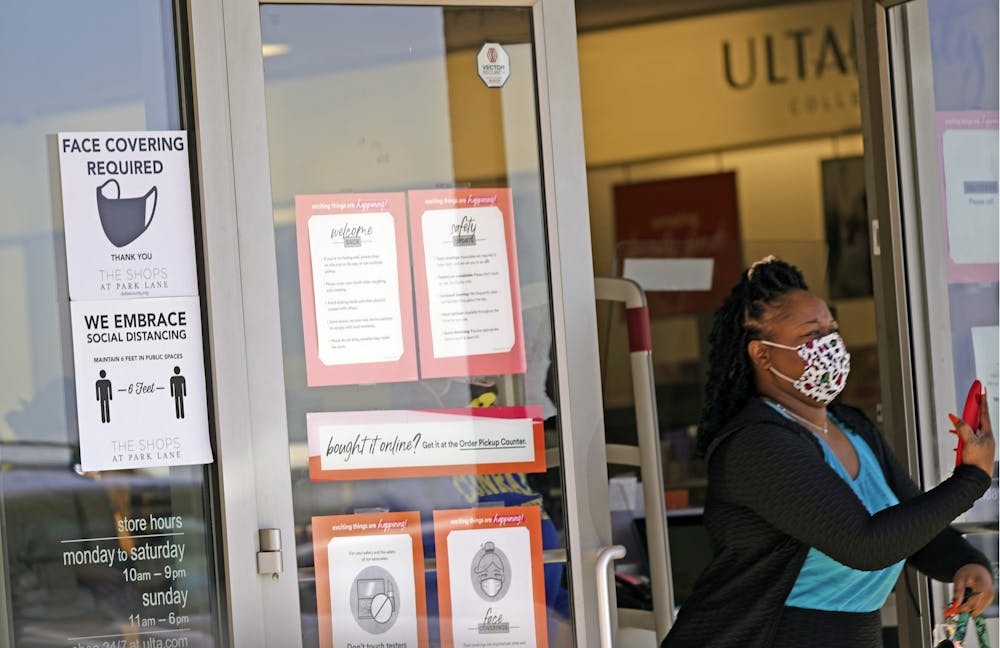
Based on current evidence, many places across the U.S. have some form of mask requirements. AP Photo/LM Otero
Mask-wearing reduced COVID-19

The first question my colleagues and I needed to answer was whether our efforts led to increased mask-wearing. Mask usage more than tripled, from 13% in the group that wasn’t given masks to 42% in the group that was. Interestingly, physical distancing also increased by 5% in the villages where we promoted masks.

In the 300 villages where we distributed any type of mask, we saw a 9% reduction in COVID-19 compared with villages where we did not promote masks. Because of the small number of villages where we promoted cloth masks, we were not able to tell whether cloth or surgical masks were better at reducing COVID-19.

We did have a large enough sample size to determine that in villages where we distributed surgical masks, COVID-19 fell by 12%. In those villages COVID-19 fell by 35% for people 60 years and older and 23% for people 50-60 years old. When looking at COVID-19-like symptoms we found that both surgical and cloth masks resulted in a 12% reduction.
The body of evidence supports masks

Before this study there was a lack of gold-standard evidence on the effectiveness of masks to reduce COVID-19 in daily life. Our study provides strong real-world evidence that surgical masks reduce COVID-19, particularly for older adults who face higher rates of death and disability if they get infected.

Policymakers and public health officials now have evidence from laboratories, models, observations and real-world trials that support mask-wearing to reduce respiratory diseases, including COVID-19. Given that COVID-19 can so easily spread from person to person, if more people wear masks the benefits increase.

So next time you are wondering if you should wear a mask, the answer is yes. Cloth masks are likely better than nothing, but high-quality surgical masks or masks with even higher filtration efficiency and better fit – such as KF94s, KN95s and N95s – are the most effective at preventing COVID-19.

Tuesday, September 14, 2021

Time to instill integrity into vaccination verification

INSIGHT ARTICLE - SEPTEMBER 8, 2021

By Howard L. Smith, Ph.D.; David N. Gans, MSHA, FACMPE; Zung Vu Tran, Ph.D., FACSM, FSS; Nina Nichols; Brett Goldman; Ryan Hawkos; and Neill F. Piland, Dr.PH.

Even before COVID-19 vaccinations began to be widely disseminated, concerns were expressed about which agencies would document and monitor them. Just as quickly, the federal government took the position that it was not going to institute a system of passports. Those who were inoculated would receive a CDC vaccination card and that was the end of discussion at that time. Well, not quite. Wishful thinking on the part of our government to avoid vaccination documentation and verification has created a formidable crisis about the integrity of vaccinations at a pivotal juncture. 

Vaccinated and unvaccinated alike want to return to some semblance of normalcy that reflects any of the millions of ways that people work, play, pray or interact. This has become possible due to widespread immunization of the U.S. population coupled with prudent social distancing and mask use, which momentarily dampened COVID-19 case counts until variants proliferated. However, as long as a sizeable number of people avoid vaccination, the virus will find ways to thrive.

Increasingly, businesses, bars and restaurants, entertainment venues, sporting events, colleges, state and municipal governments, the Veterans Administration and federal agencies require proof of vaccination or continual tests. This has nurtured fertile ground for counterfeit cards. Anti-vaxers do not want to be prevented from partaking in such activities; plus, many people simply enjoy beating the system or proving that no one can make them do what they do not want to do regardless of the expense to their health or society. This self-centeredness is costing the United States some $2.3 billion in hospitalization for unvaccinated people during June and July 2021 alone.1

As we struggle to reopen our society and rejuvenate our economy, the long-ignored challenge of instilling integrity into vaccination documentation must be overcome. But does anyone really trust that the person sitting, standing or otherwise in their personal space has actually been vaccinated as they espouse or claim with a little sheet of paper? Remember, it only takes one exposure to acquire a virus that might kill you.

The preceding thoughts clearly underscore that it is past time for a viable and efficient vaccination verification system. Such a system would function much like the Good Housekeeping Seal of Approval or OSHA’s “Nationally Recognized Testing Laboratories,” in which valid third-party organizations with appropriate qualifications perform safety testing and certification of products. The CDC, or other health-related agency, could oversee a national vaccination verification system. For example, sources approved by the CDC (e.g., Nationally Recognized Verification Entities) could create highly recognizable electronic passports that substantiate COVID-19 vaccination. The technology and products already exist as private firms have looked ahead to now — when vaccination certification would be paramount to a functioning society.

Currently, the lack of a secure verification system is facilitating fraud as people falsify credentials, forge vaccination cards or hack digital certification tools to meet entry requirements for health facilities, mass gatherings and places of business. Physical and digital health records such as the CDC card and IBM’s Excelsior pass have been easily falsified.2

Cell phone-enabled vaccination verification should be an immediate reality. The world relies on cell phones to do most anything and everything. Verification needs to be easy to use at point of entry (e.g., into a restaurant, bar or entertainment venue), inexpensive, and widely recognized as one of the CDC-approved “Good Health Keeping Passports of Vaccination.” This will facilitate disease prevention, efficient use of health services and facilities and reduce healthcare costs, as well as invigorate economic activity and development.

It is time to quit stalling. All along we have known that there would be a need for bulletproof verification of vaccination to re-boot societal functioning. Let’s invest a modicum of resources in a reliable vaccine verification/certification system of high integrity as we have in developing the vaccines and confidently move onward and upward.

Sunday, September 12, 2021

The Physiology of Treading Water Efficiently

OUTSIDE magazine
Alex Hutchinson
Sep 9, 2021

A new study measures the physical and cognitive load of four different treading techniques. 
The key? Generate lift.  

On a canoe trip down the Spanish River in northern Ontario last month, my friends and I kept noticing an unusually high concentration of really, really big leeches lurking at the shores of our campsites. As a result, our pre-dinner swims involved paddling our canoes out to deep water then jumping in from there. 

This gave me lots of time to think about treading water: how long I’d be able to keep it up if necessary, if I was doing it properly, and whether that even mattered. Imagine my surprise, then, when I got home and saw this paper, just published in Frontiers in Physiology by Tina van Duijn of the University of Otago and her colleagues: “A Multidisciplinary Comparison of Different Techniques Among Skilled Water Treaders.” 

They put 21 volunteers, all experienced water polo players, synchronized swimmers, or competitive swimmers who self-identified as water-treading experts, through a series of physiological and cognitive tests while performing four different styles of treading. 

The verdict: some techniques really are substantially better than others. The four techniques are as follows: 

Running in the water: This one is pretty self-explanatory. Hands and feet are moving up and down in a running-like motion. 

Flutter kick: Your hands are sculling back and forth along the surface of the water, while your legs do a flutter kick. 

Upright breaststroke: Your hands are still sculling along the surface of the water, but your legs are doing the distinctive frog kick of the breaststroke. 

Eggbeater: It’s similar to the upright breaststroke, with the key difference that your legs are kicking one at a time instead of synchronously, producing an eggbeater pattern of alternating circles with each leg. 

Like pretty much everyone who took swimming lessons as a kid, I was taught the eggbeater. But as I floated down the Spanish, I realized that over the years I’ve settled into a comfortable upright breaststroke style as a default. In fact, I wasn’t really sure how to do the eggbeater anymore—which, as I thought back to an article I wrote a few years ago called “How to Survive 75 Hours Alone in the Ocean,” vaguely worried me. 

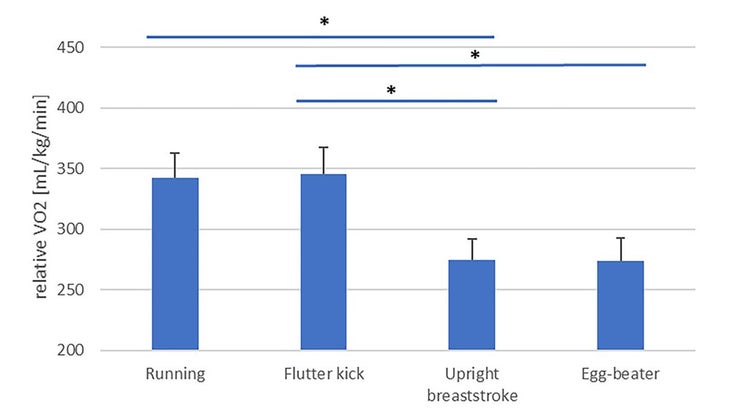
Was I working way harder than I needed to in order to stay afloat? It turns out I’m not alone in my habits. Among the expert water treaders in the study, 71 percent of them opted for eggbeater in their warm-up, but 14 percent each chose upright breaststroke and flutter kick. There were clear differences in how efficient the different techniques were, with running and flutter kick performing equally poorly, and upright breaststroke and eggbeater performing equally well. This pattern showed up in every outcome measure. 

For example, here’s the oxygen consumption (VO2) during the last portion of 3.5-minute test bouts, measured through a breathing mask attached to a snorkel: (Photo: Frontiers in Physiology) Oxygen consumption is roughly proportional to energy consumption, so the lower values for breaststroke and eggbeater mean they’re more efficient than the other two strokes. Aside: these values are adjusted based on the “wet weight” of each participant, which was measured by weighing them underwater. 

Normally VO2 measurements are adjusted for weight, since heavier people burn more energy—but in this case, wet weight was used to also account for differences in buoyancy. 


As a guy who sinks like a stone in water, I found this interesting! Similarly, heart rate was higher in running (140 beats per minute, on average) and flutter kick (147) than in breaststroke (129) and eggbeater (129). 

Same for perceived effort: 14 and 13 on the Borg scale from 6 to 20, versus 11 and 11, respectively. For cognitive load, they used the NASA-Task Load Index, which assesses things like effort, frustration, and perceived performance, and they tested reaction time in response to visual and audible signals. In both cases, breaststroke and eggbeater produced better results than the other two. 

There’s some interesting physics in the stroke comparisons. The two inferior techniques largely rely on pushing down against the water to move the body upward. This has two problems: water is too thin to provide much support, and even when the pushing works you get a lot of wasted up-and-down motion. The two better strokes, in contrast, involve lateral movements of the arms and legs: your cupped hand acts like an airplane wing or sailboat sail, generating lift forces perpendicular to the plane of motion. This is more efficient than pushing on the water, and produces less wasted vertical bobbing. 

 There’s one key difference between upright breaststroke and the eggbeater: in the former, your legs are kicking outward at the same time, while in the latter they’re alternating. This means that breaststroke produces some of that undesired up (when you kick) and down (between kicks) motion—and that effect is exacerbated if you stop sculling with your hands. 

In the eggbeater, there’s always one leg moving, so you get a smoother, more continuous lift that can keep you up even without your hands. The study didn’t test anything that required using your arms—but if you want to throw a water polo ball, strike a fancy pose during your synchro routine, or signal frantically to a passing ship that you need rescue, eggbeater looks like a much better bet. Next time I’m in deep water, I’m going to see if I can get the hang of it again.

Wednesday, September 8, 2021

Surprising ways you may be getting sun-damaged skin (From Kaiser-Permanente)

Make coffee. Eat breakfast. Brush your teeth. Take a shower.

This typical morning routine is missing an important step: Put on sunscreen.

Why should you wear it every day? Because sun-damaged skin may be sneaking up on you.

You know you and your family should wear sunscreen before spending a long afternoon outdoors, but sun damage is cumulative — short periods of unprotected sun exposure add up over time, eventually leading to visible damage to your skin and a higher risk of skin cancer.
What is sun damage?

Sun damage, or photoaging, is when ultraviolet (UV) light from the sun prematurely ages your skin. There are 2 kinds of UV light — UVA and UVB. UVA light damages skin at all levels, from the surface to the deepest layer, breaking down collagen and elastin fibers. UVB light damages the outer layer of skin and your DNA, which can lead to cancer. A simplified way to remember the difference is that UVA rays are aging and UVB rays are burning. If you have darker skin, it’s less likely to burn — but it can still be damaged by UVA rays.

Signs of sun-damaged skin include:
• Broken capillaries, usually around the nose
• Loss of skin elasticity
• Pigmentation changes, such as age spots and brown patches of discoloration (known as melasma)
• Red blotches
• Uneven skin texture
• Wrinkles

For a safer, healthier summer glow, try sunless tanning.

Surprising Ways you may be getting sun damage

Direct sun exposure occurs anytime you’re outdoors unprotected. Indirect sun exposure is when something is partially protecting you from the sun, like a window. If you’re not wearing adequate sunscreen, these exposures add up and lead to lasting sun damage.

“People are running errands — 5 minutes here, 10 minutes there — or walking their dog, and they’re not taking into consideration the cumulative, short bursts that they’re getting,” says Sarah Adams, MD, a dermatologist at Kaiser Permanente Southern California. “All of the sudden, they’ve been outside for an hour and a half and they haven’t worn any sunscreen or any sun protection.”

Some examples of surprising sun exposure include:
• Short trips outdoors, like walking from a parking lot to a building
• Being under shade, like an umbrella
• Clouds covering the sun
• Sitting next to a window — including in your home office, working at a drive-thru, or traveling in a car, bus, or airplane

And yes, you read that last one right — you should even wear sunscreen when you’re home all day if you’re near a window. Windows usually block UVB rays, but not UVA rays.

“When I see patients in clinic, I notice more photoaging — more dark marks, more pigmentation — often affecting the left side of their face,” Dr. Adams says. “I can often tell that someone was a driver versus a passenger because of the amount of sun damage that there is on one side of their face versus the other.”

Your skin can also become more sensitive to the sun if you’re on certain medications or skin products — so take extra care to protect yourself. Read the labels or check with your doctor if you’re using:
Acne medications like Accutane
Antibiotics, particularly tetracyclines
Some birth control pills
Some heart medications for arrhythmia
Topical skin products such as retinols, glycolic acid, and other alpha hydroxy acids
How to protect your skin from sun damage

Use sunscreen with SPF 30 or higher on yourself and your kids every day to prevent sun damage. Look for a broad-spectrum formula, which protects from both UVA and UVB light. Encourage your teens and older kids to use it daily, too.

Besides your face, be sure to apply sunscreen to commonly overlooked areas, such as your ears, the sides and back of your neck, the V of your chest, and the backs of your hands.

Get fast, easy coverage by wearing long-sleeved shirts and pants, a wide-brimmed hat, and sunglasses. Invest in clothes with UPF (ultraviolet protection factor) for extra protection.

Limit how much time you and your family spend outdoors between 10 a.m. and 2 p.m. when the sun’s rays are strongest. But remember, UV rays can be a concern anytime the sun is up. Use your smartphone’s weather app to check the current UV index — if it’s 3 or higher, you should protect your skin.

Some good news — you don’t need to reapply sunscreen throughout the day if you’re not sweating or swimming. Just make it part of your daily morning routine.

Monday, August 30, 2021

I Can’t Stop Thinking About This Subreddit That Collects COVID-19 Deniers Who Then Suffer the Worst

From Digg


On Reddit, there’s a forum called r/COVIDAteMyFace. It’s a sort of spin-off of r/LeopardsAteMyFace, which is a repository for news steeped in the repercussions of someone’s actions. “Revel in the schadenfreude anytime someone has a sad because they’re suffering consequences from something they voted for or supported or wanted to impose on other people,” reads the r/LeopardsAteMyFace description.

“Leopards Ate My Face” is a reference to a viral tweet from author Adrian Bott (@cavalorn) in October 2016, following the Brexit vote: “‘I never thought leopards would eat MY face,’ sobs woman who voted for the Leopards Eating People’s Faces Party.” I’ve been subscribed to r/LeopardsAteMyFace for a while, because, well, there is a certain kind of schadenfreude that results from seeing people realize that the terrible policies they vote for—often with callous or intentional disregard for other people—can hurt them, too.

But r/COVIDAteMyFace feels very different. After a friend sent me the link yesterday, I read through the posts there for hours and felt only sadness, shame for America, and a white-hot rage at those who knowingly peddle disinformation about the pandemic, along with the social media networks (primarily Facebook, but also increasingly places like TikTok) that have allowed awful COVID-19 memes and outright lies to spread.

Even after Facebook vowed to combat disinformation back in February, their own recent reports have shown that the most popular posts on the network cast doubt on vaccination. Many of the anti-mask and anti-vax Facebook screenshots shared by people r/COVIDAteMyFace were posted just days ago.

Again and again and again throughout the entries on r/COVIDAteMyFace, we see the same patterns. Someone has spent months sharing Facebook memes and status updates about medical “freedom,” not being a vaccine “lab rat,” conspiracies about the vaccine, relentlessly mocking apparent go-to boogeyman Dr. Fauci, the disparagement of masks and mask mandates, and more.

Alongside these screenshots, there are then follow-up posts from the same people or their family members reporting that they are now in serious condition in the hospital with COVID-19 and usually asking for prayers and “prayer warriors.” More often than not, there’s an additional post reporting that the COVID-19 denier and/or anti-masker/anti-vaxxer has died. With the rise of the wildly infectious Delta variant, the number of cases like this has skyrocketed.

There’s no satisfaction to derive from these posts. They’re a vast human tragedy told in the arc of screengrabs from social media. The subreddit also hosts article after article recounting further tragedies: the anti-vax parents who died weeks apart, leaving behind four children; a 34-year-old father who died after wanting to wait a year because social media made him feel uncertain about the vaccine; unvaccinated pregnant people and babies dying; endless testimonies from those hospitalized or on their deathbeds expressing regret that they did not get the vaccine.

If I read another story about people begging for the vaccine when they’re being intubated, I may scream. The pandemic was already a nightmare, but the rampant ignorance and active campaigns to make people afraid of highly effective, widely researched vaccines or to push back against the simple act of wearing a mask feel criminal at this point.

Who is responsible for making anyone think and believe that “this isn’t that real of a virus”? And why do people continue to believe this 18 months in, with more than 4 million people dead?

I am usually in diametric political opposition to many of the people whose stories are on r/COVIDAteMyFace. I am furious at anti-vaxxers and opportunistic politicians instituting laws against basic health protocols for political clout. But I grieve the death of every person lost to COVID-19—and every loss of human life is a catastrophe with ripple effects far beyond that person.

These people were often beloved spouses, lovers, parents, siblings, aunts, uncles, grandparents, cousins, friends, coworkers. Some were primary caregivers and breadwinners who will leave despair in their wake. They had vibrant lives that went far beyond political parties and bad memes.

Losing someone that you love, especially at a young age, is one of the most difficult things that will ever happen to those left behind. I know this personally. But I cannot even begin to imagine how it would feel to grapple with the knowledge that your loved one’s death could have been prevented with a free and immensely effective vaccine. Even from the outside, that knowledge feels crushing. Worldwide, at least two million children at minimum have lost a parent or a grandparent caregiver to COVID-19. It’s unfathomable to imagine the suffering that people will carry with them.

r/COVIDAteMyFace serves an important purpose. It documents for posterity how America’s response to COVID-19 went completely off the rails, and yes, it demonstrates how personal actions can have devastating consequences. If scrolling through the tragedies there makes even one “vaccine-hesitant” person get the vaccine, it will have served a great purpose.

Some of the commenters on this forum seem to revel in the outcomes as anti-vaxxers getting their due, and that can feel ghoulish. Yet many are also exhausted at fighting disinformation for more than a year, and rightfully upset about the impact COVID-19 deniers who then get COVID-19 can have on others. It can feel hard to extend sympathy to people who seem to be choosing Facebook medical advice over the combined endorsement of the majority of doctors and scientists around the globe.

Beyond the ramifications of death or serious illness to those in the person’s circle, these people can also infect others in their disregard for health measures. They can be responsible for more deaths or horrifying cases. They’re impacting the ability of businesses and offices to reopen. They’re making schools dangerous for kids, many of whom cannot yet be vaccinated. And the trauma experienced by the healthcare professionals who must care for and try to save everyone involved is already at a disastrous crisis point.

There are no easy answers, but what is starkly revealed when reading through r/COVIDAteMyFace is just how much social media has influenced people’s opinions amid the crass politicization of an international medical emergency. Social media networks, alongside politicians against mask mandates and “news” outlets that push vaccine skepticism and virus conspiracy theories, all have blood on their hands. In America, a lot of initial blame can be laid squarely at the feet of Donald Trump and the GOP for their constant downplaying of the virus and pushback against masks. But Trump is gone now and the misinformation has only dug in its heels.

Were Dante to write a modern-day Divine Comedy, I think there’d be a special layer of hell in “Inferno” for those who broker in pandemic disinformation for fun or profit. I imagine it as an infinite pediatric COVID ward where the only people you can speak to are the souls of once-vehemently anti-vax right-wing radio hosts who have died.

If anyone should feel the ramifications of their actions right now, it’s those who pushed others into the realm of fear and paranoia. It was found that just 12 people were responsible for generating a majority of “misleading claims and outright lies” about the pandemic on social media. It’s wrenching to consider the countless people suffering the consequences.

(via Reddit, image: Pexels, r/COVIDAteMyFace)

Tuesday, August 24, 2021

Telephone Disruption

 For reasons that we cannot discern, our primary line (301.421.4433) is not ringing through the switchboard. Our other numbers, which do not roll over, are working: 301.421.9529 and 301.421.0096 are working. You can choose an extension and leave a voice message any time of day. 

Wednesday, August 18, 2021

THOUGHTS ON AFGHANISTAN, from a senior military officer

I ask that you not use my name. I am a currently serving General Officer and what I have to say is highly critical of our current military leadership. But it must be said.

I don’t blame President Biden for the catastrophe in Afghanistan. It was the right decision to leave, the proof of which is how quickly the country collapsed without US support. Twenty years of training and equipping the Afghan army and all that they were capable of was a few hours of delay in a country the size of Texas. As for his predecessor, the only blame I place on President Trump was that he didn’t withdraw sooner.

We should blame President Bush, not for the decision to attack into Afghanistan following 9-11, but for his decision to “shift the goalposts” and attempt to reform Afghanistan society. That was a fool’s errand any student of history would have recognized. And yes, we should place blame on President Obama for his decision to double down on failure when he “surged” in Afghanistan, rather than to withdraw.

However, most of the blame belongs to the leadership of the US military, and the Army in particular. The Washington Post’s “Afghanistan Papers” detailed years of US officials failing to tell the truth about the war in Afghanistan, “making rosy pronouncements they knew to be false and hiding unmistakable evidence the war had become unwinnable.” That report was two years ago, and the stories within it began more than a decade before that. Afghanistan was, and always will be, “unwinnable”.

Of course, I blame President Biden for the disastrous retrograde operation still unfolding. But let us not allow that to deflect us from heaping even more blame on military leaders. They stonewalled President Trump rather than beginning deliberate preparations to exit the country when he told them to. They thought that they could outlast him and then talk sense to his successor. Then after the inauguration, they pressed the new president to reverse course. He wisely chose withdrawal. Then and only then did the generals begin their preparations in earnest. But it was too late to do it well.

The war in Afghanistan lasted more than twice as long as the Vietnam War. Although the cost in terms of American blood was thankfully far smaller, the mistakes are the same: America got involved in a long land war in Asia, in a peripheral region, in order to prop up a floundering and unreliable government, and at a time when there was a much bigger looming threat. In fact, Afghanistan was worse than Vietnam in that at least the Vietnam War was tangentially related to the effort to stop the global spread of communism during the Cold War. Afghanistan was worse than Vietnam in another respect: the military’s leaders of the Vietnam era had no precedent to dissuade them from a disastrous path. Today’s military leadership has the precedent of not just Vietnam, but also Iraq, Lebanon, Libya, Syria, and Yemen. That much obtuseness must be punished and removed from the system.

General Milley must resign. Not only is he the Chairman of the Joint Staff, prior to that he was the Chief of Staff of the Army. While all services share the blame, the Army is the land domain proponent. The 20 years of failure in Afghanistan is an Army failure. Scores of other generals also deserve a thorough evaluation; many of them are complicit in the lies to protect a decades-long failed strategy.

Secretary of Defense Austin also must be fired. The recently retired Army general and former CENTCOM commander was, and still is, part of the culture that is impervious to the fact that 20 years of trying it their way did not work.

Just as it did after Vietnam, the military, and especially the Army, must conduct a comprehensive review of why it exists. The purpose of the Army is to visit profound violence on our nation’s enemies; it is not to rebuild failed states. We have decades of experience: counter-insurgencies and nation-building does not work for America. We do not have the stomach for long wars of occupation—and that is a good thing. We are a nation of commerce, not conflict. A constellation of retired stars will tell you that the two can coexist. They are wrong. Retired Vice Chief of Staff of the Army General Jack Keane said only two months ago that because Afghanistan consumes just a small portion of the force, America “can afford the cost of fighting” there. What he does not see is that for 20 years, that “small portion” was the most important portion of the military. Everything else necessarily is subservient to the portion of the force in conflict. It has altered who the Army is and how it thinks. 

There exists only a handful of officers below the general officer ranks who served during the Cold War and who have lived through an era of great power conflict. From private through brigade commander, virtually every Army Soldier serving today has experienced little other than counterinsurgencies or nation-building while operating out of secure FOBs. Large-scale combat operations and insurgencies require different cultures and mindsets. In a resource-constrained environment, the same service cannot do both well. The Army today could not win a major war. Yet, winning a major war is the number one reason why an Army exists. It will take a generation to break bad habits, to think in terms of closing with and destroying the enemy versus winning hearts and minds. Keane sees raw numbers (and ignores the stark evidence that there was no progress over 20 years) and thinks that America’s Army can sustain that level of commitment. It cannot, and the opportunity cost to the culture of the force is much too great. Ignore him. Ignore Petraeus, McMaster, Stavridis, and the rest of their ilk.

Concurrent with its review of purpose, the Army must reevaluate its size and how it is organized. The active component is much too large. That makes it too eager to get involved in irrelevant theaters where failure is likely or even preordained. It should be very difficult for an American president to deploy the Army without the National Guard performing most combat operations. You argue that that takes time? Yes, that’s the point: it should take time to make the case to the American people that war is worth it.

The Marine Corps must provide the nation’s rapid response forces. It is a self-contained deployable multi-domain force. Some would argue that the service has both insufficient combat power and staying power. However, that is a feature, and not a flaw, as it forces the nation to rely on its Army—and hence its reserve components—before engaging in heavy combat or lengthy operations. The current Commandant of the Marine Corps, General Berger, already seems to recognize his service’s role—hence his decision to eliminate armor from the Corps.

Congress must reevaluate the authorities contained within Sections 12301 through 12304 of Title X. The president has too much latitude to, on his own authority, mobilize tens or even hundreds of thousands of Guardsmen and Reservists without congressional approval. It must be the policy of the United States that we do not place our service members in harm’s way without first making the case to the American people. This also means ending the 2001 and 2002 Authorizations for Use of Military Force as well as strengthening Congress’ role in the War Powers Act such that, absent an actual declaration of war, there can be no war.

Some would argue that such a constraint would limit the nation’s ability to respond to a Russian incursion in the Baltics or a Chinese attack on Taiwan. However, recent open-source studies conclude that the US military already is unable to defend against either attack. Pretending otherwise while not having the means to back up our assurances unnecessarily emboldens our partners and allies, making such an attack more likely. We lose nothing by making the law match the reality.

Let us not forget the intelligence agencies. They reported that Kabul was at risk of falling in as little as 90 days. That report was from last Thursday! The capital fell in less than 90 hours. Failure must be punished. And punishment in a bureaucracy means mass firings and a smaller budget—not more money so that they might be better the next time. Congress must consolidate and collapse our intelligence agencies. And when its reorganization is done, if the overall size of the nation’s intelligence apparatus is a quarter of what it is now, that still is too large.

And while we are on the topic of “too large,” DoD must be halved. There are too many flag officers, too many agencies, departments, and directorates. It is the only secretariat with independent but supposedly subordinate secretaries. There are too many Geographic Component Commands—each led by a 4-star virtual proconsul whose budget dwarfs what the Department of State spends in their regions. The result is a foreign policy that is overly military and underly diplomatic, informational, and economic. Congress must revisit the 1947 National Security Act and the 1986 Goldwater-Nichols Act. Both were good for their times, but after decades of experience, there clearly are new reforms necessary.

Unreformed, DoD is an inscrutable labyrinth that invites fraud, waste, and abuse. The excess attracts unscrupulous camp followers. Amazon did not choose Crystal City to locate its new headquarters because of low rents and ease of transportation access for its 25,000 employees. It chose the Arlington, Virginia neighborhood because it is two blocks from the Pentagon. That building controls the distribution of three-quarters of a trillion dollars every year. Most of it is wasted. The excess is apparent in the scores of class-A high rises housing defense contractors just blocks from the Pentagon. To end that waste, nothing so concentrates the senses as austerity.

Let me conclude with one last thought: the generals, the intelligence analysts, the defense contractors, and the pundits all leveraged America’s rarest resource: the American serviceman and woman. They are the ones who fought, and sweat, and bled, and died for what is now clearly a failed strategy and a doomed mission. Even after its failure was apparent to their leaders, they continued to enlist and reenlist, largely because their superiors—the experts—assured them that success was possible. It was not. It never was. Absent American support, Afghanistan collapsed over the length of a long weekend. That is proof enough that the last 20 years were in vain, and proof enough that the system is broken from within.

“Failure must be punished.” An idea so crazy it just might work.