Tuesday, December 27, 2022

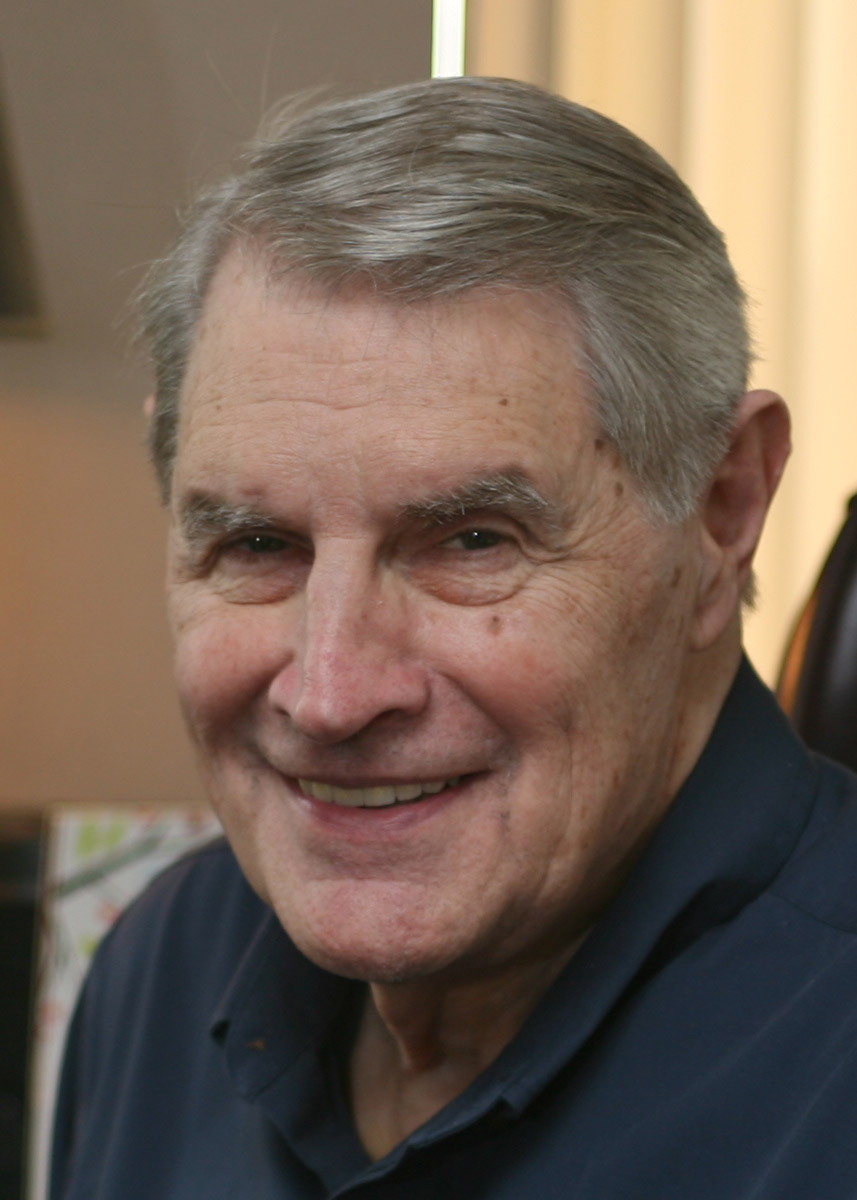
Dr. Richard A. Schwartz, MD, F.A.C.P., F.A.C.C.

Dick Schwartz entered my life as an adjunct professor at the University of Maryland. I signed up for the six credit hour course- Cardiovascular Physiology and Pathology. From that stepping stone he was a member of our FEMA-funded, ground-breaking research tesm, conducting the first-ever study of the metabolic demands of structuiral fire suppression. We identified the aerobic and anaerobic constructs and contributions to working encumbered with SCBA and the PPE. 

Our friendship with Dick and his wife grew through life events including his marriage, his professional advancemet and later in setting up an Occupational Medicine practice in the Greater Washington, DC area. 

I was honored to serve as a pallbearer and call him friend. The official obituary follows. 

It is with great sadness and regrets that the physicians and staff of Cardiology Specialists of Virginia note the passing of Dr. Schwartz on December 20, 2022. Dr. Schwartz was a dedicated physician who dearly cared for his patients and loved his profession; he was our colleague and friend.

Dr. Schwartz began his private practice in the Northern Virginia area in 1974. He was the founder and medical director of a group cardiology practice in Arlington and Alexandria, VA. from 1974 to 2000. Dr. Schwartz received his medical degree from Cornell University in 1965. He served his Internship at Philadelphia General Hospital. His residency training was done in the Georgetown University Hospital program at D.C. General Hospital. Cardiology Fellowships were completed at Georgetown University Hospital and the Washington Center Hospital. He was Board Certified in Internal Medicine and Cardiovascular Disease. Dr. Schwartz held the rank of Lieutenant Commander during his military service in the U.S. Public Health Service. He was a Clinical Assistant Professor of Medicine at Georgetown University Hospital of Medicine. At the University of Maryland, he served as a consultant in cardiology, sports medicine and physical fitness. He was a Director of the Northern Virginia Institute for Continuing Education, Chairman of the Board for the Medical Society Services and Treasurer of the Medical Society of the District of Columbia. Dr. Schwartz was past Chairman of the D.C. Medical Society Committee on Physical Fitness and a charter member and past President of the Sports Medicine Association of Greater Washington. He was a frequent guest speaker and author on various healthcare and fitness topics. Active in rowing for over 30 years, Dr. Schwartz was a senior master sculler and has participated in the sport as a crew member, coach, and team physician. He was a member of national championship crews and rowed on the 1963 Pan American team.

Wednesday, December 14, 2022

From the Wall Street Journal

The current era is marked by fading trust in U.S. institutions, but confidence in one pillar has held up: the military. But now even that is eroding, and the question is whether the brass will get the message.

The Reagan Institute releases an annual survey of public attitudes on national defense, and this year only 48% reported having “a great deal of confidence” in the U.S. military in results first detailed here. That’s down from 70% in 2018, and within the margin error of last year’s 45%.

This is consistent with other surveys. Pew Research this year noted a 14-point drop since 2020 in Americans who said they had a great deal of confidence in the military to act in the public’s interest.

The Reagan poll asked Americans what is driving the decline. It isn’t the ability to carry out missions or win in a fight. It is “things going on outside the core competencies of the military,” says Reagan’s Roger Zakheim. “Call it politicization, call it wokeness,” but that’s where “you can connect the dots.”

Some 62% said “military leadership becoming overly politicized” reduced their confidence some or a great deal. That includes trust in civilians who give the orders. Americans offered some of the worst ratings for decisions made by Presidents, and the U.S. retreat from Afghanistan comes to mind.

Some 52% also had reduced confidence in uniformed officers. Half cited “so-called ‘woke’ practices undermining military effectiveness.” Some of these episodes—a brouhaha over maternity flight suits—are overblown. But others are revealing: An admiral suggested last year that to increase diversity the Navy should consider reviving the practice of looking at photos in promotion boards—i.e., to make decisions based explicitly on race.

General Mark Milley’s speech to Congress last year that he wanted to understand “white rage,” in response to reasonable inquiries about whether cadets at West Point should be learning critical race theory, was a lapse in judgment. Many Americans think the military is no longer an institution that runs on excellence, merit and individual submission to a larger cause.

The Pentagon denies this is a problem, but it surely is if half the public believes it. The military relies on young Americans to sign up amid many other career opportunities. Fewer are doing so. Americans on the left have their own reasons for declining confidence in the military: 46% cited right-wing extremism, even though this scourge has been wildly overstated.

This drop in confidence comes at an ominous moment, as the public seems to know. Some 75% in the Reagan survey viewed China as an enemy, up from 55% in 2018, and the percentage of those worried about Russia has doubled. Some 70% are concerned China might invade Taiwan within five years, and 61% support increasing the U.S. military’s Pacific footprint.

The good news is that these trends can be reversed, as they were in the years after Vietnam. As GOP Rep. Mike Gallagher put it to us, the poll is helpful in narrowing “what our failures are,” and it isn’t the rank-and-file or even the equipment. “Ukraine has been one long advertisement for American weapons systems.” But “it seems to be the leadership.”

Americans want their military to focus on preventing or winning the next war, not on serving the latest political fashion.

Saturday, December 3, 2022

Intellectual Property Defined

What is IP, or "Intellectual Property?"

From the The American Heritage® Dictionary of the English Language, 5th Edition:

Any of various products of the intellect that have commercial value, including copyrighted property such as literary or artistic works, and ideational property, such as patents, business methods, and industrial processes.

The set of rights protecting such works and property from unlawful infringement.

Any product of someone's intellect that has commercial value: copyrights, patents, trademarksand trade secrets.

So, going back in history to 1976, the elements of the Firefighter Challenge meet the definition; that is, any form of Climbing a stairway under load, hoisting with gloved hand a weight, simulated "chopping" with a sledge hammer, (or ax), advancing a charged hose and "rescuing" a mannequin is a derivative of the original work of Dr. Paul Davis. His research was published widely in copyrighted publications and trademarks registered in the United States and the EU.

The words: Firefighter Challenge cannot be trademarked because they are too broad. But the stylized version of the words and associated trademarks can be protected.
Also, the published rules on the official website are copyrighted. "Knockoffs" abound. Which brings us to the subject of Intellectual Honesty.

"If I don't call it the Firefighter Challenge, am I not stealing?"

Yes you are. In an attempt to be perceived as original thinkers, some organizations "tweak it" to demonstrate a difference that would suggest that this was their idea. Yet, the order effect is still there. But the idea was NOT theirs. It's been 46 years since the first Challenge course was created. The legacy of records has been meticulously maintained to provide value and reference for benchmarks around the world. Interestingly, the popularity of the Challenge is demonstrated by the hundreds of postings on YouTube.

You can develop your own version of the Olympic Decathlon, but the coin of the realm, time or points are not going to have meaning if what you're doing is different. Here in lies the value of a "Brand." And that’s why imitators need to be called out. Simply answer the question "where did you get the idea for your version of the truth?"
  • Wednesday, November 23, 2022

    The Salt in Sports Drinks May Not Be As Crucial As You Think

    Replacing lost salt is a pillar of sports nutrition, but new research suggests more isn’t always better
    Alex HutchinsonNov 4, 2022
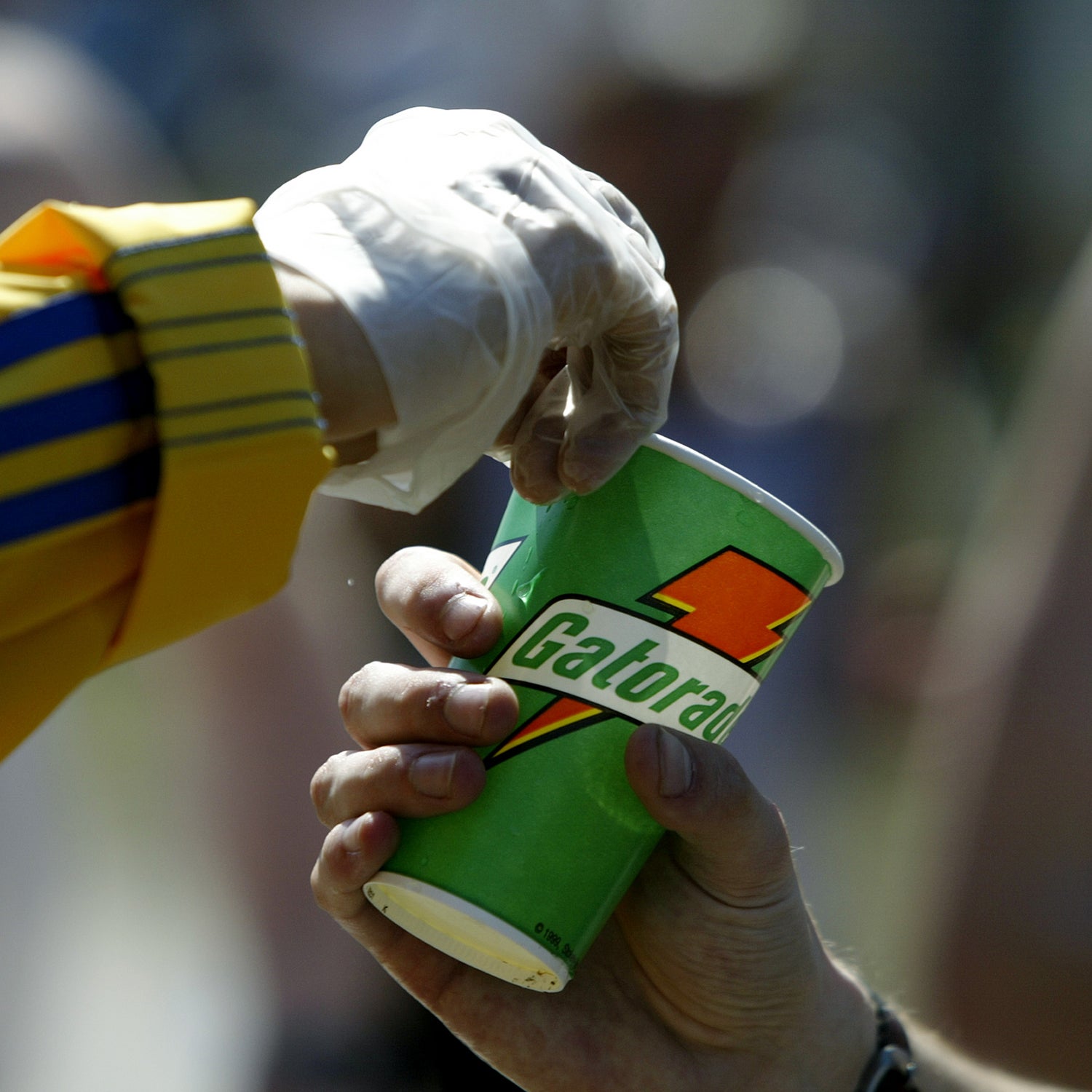
    A detail shot of a volunteer as he hads a Gatorade refreshment cup to a runner as he passes through a water station in the town of Natick during the Boston marathon


    In the mid-1960s, a researcher at the University of Florida named Robert Cade went to a bank and borrowed $500 to buy sugar and salt. The homemade drink he’d devised for the university’s football team, dubbed Cade’s Cola—or Gatorade—was attracting widespread attention, and he wanted to mix a big batch of it to sell. The sugar provided crucial fourth-quarter energy for the players, and the salt—well, scientists and athletes are still debating what role the salt in sports drinks plays in athletic performance.

    The question lurks in the background of a new study published in the European Journal of Sport Science, by sports nutrition researcher Alan McCubbin of Monash University in Australia. The study uses a mathematical model to determine exactly how much sodium is required during exercise of varying intensities and durations, depending on how much a person sweats, how salty that sweat is, how much they drink, and other factors. The answers depend on the assumptions we make about why athletes need salt. But in the vast majority of real-world situations, McCubbin concludes, we don’t need to worry about it.

    There’s no doubt that sodium—the key electrolyte in salt—has a number of crucial responsibilities in the body. It helps muscles contract, conducts nerve signals, and keeps internal fluid levels balanced. It’s also true that we lose sodium through sweat. In the 1930s, after at least 13 workers died of heat exhaustion during the first year of construction on the Hoover Dam, in Nevada, tests conducted by Harvard physiologist D. B. Dill revealed that the workers were sweating out large quantities of sodium. The solution: in the dining hall, alongside a sign that read, DRINK PLENTY OF WATER, Dill’s team added, AND PUT PLENTY OF SALT ON YOUR FOOD.

    But taking in salt during exercise is another matter. There are three principal reasons you might want to do this. The most frequently cited is to ward off muscle cramps, but scientific evidence largely contradicts this idea. Studies involving runners and triathletes have found no significant difference in sodium levels between those who experience cramping during exercise and those who don’t, and deliberately lowering those levels appears to have no effect one way or the other. There are many reasons why we cramp, and sodium may be involved in some of them. But when it comes to exercise-related cramping, increasing our salt consumption doesn’t appear to be the solution.

    The second reason to boost salt intake while exercising is to avoid hyponatremia (literally, low blood sodium)—a dangerous and occasionally fatal condition. On paper, drinking something salty would seem like a good way to ensure healthy sodium levels. But sports drinks are less salty than blood, so the more you chug, the more diluted your blood becomes. As a result, the main risk factor for hyponatremia is actually taking in too many fluids—be it water or sports drinks—not too little salt. That’s why current guidelines advise drinking when thirsty rather than following an aggressive hydration plan.

    The third reason is the one McCubbin considers legit: regulating fluid concentrations. The human body is replete with fluids—in the blood, in the cells, and in the spaces between cells. Your body monitors sodium levels to decide how to allocate fluid stores among these three areas. That means you’ve got a buffer when you start exerting yourself; even though you’re sweating, water from other localities can shift into your blood plasma to maintain sodium concentration. However, if prolonged sweating depletes sodium levels too much and you’re only drinking water, the opposite happens: fluid shifts out of your plasma to keep concentrations from dropping elsewhere, leaving you with lower blood volume to ferry oxygen to muscles and dissipate heat. That, in theory at least, is a problem.

    The relevant question, then, isn’t how much sodium you need in order to replace what’s lost to sweat. It’s how much you need to keep your blood concentration from dropping, taking into account that your body is moving fluid around internally. Crucially, the answer doesn’t just depend on how much sodium you sweat out; it also depends on how much fluid you take in.

    “There’s a big difference between losing four liters of salty sweat in a marathon and replacing two liters of that with plain water, and losing 20 liters in a 100-miler and replacing it with 18 liters of plain water,” McCubbin explains. In both cases, you’ve lost the same quantity of fluid: two liters, or 4.4 pounds of body weight. But it’s really the turnover that matters. In the latter instance you’ve sweated out far more sodium, and are therefore more likely to exceed your body’s ability to compensate for the loss.

    For his study, McCubbin used equations developed by kidney specialists to calculate blood-sodium concentration. Among soccer players and marathoners, he concluded, making a deliberate effort to replace sodium beyond what taste preferences dictate is “unnecessary in all realistic scenarios.” In 100-mile ultramarathons, where longer duration results in far greater salt loss, the picture is more nuanced. For runners whose sweat is saltier than average and who aim to drink aggressively enough to limit fluid losses to 2 percent of their starting weight, drinking water alone would leave them short on sodium. (These ultras are so taxing that runners also lose weight from the carbohydrate and fat reserves they burn, so they may be 3 to 5 percent lighter on the scale by the time their fluid losses hit 2 percent. That’s about what current hydration advice for ultramarathoners recommends.)

    The sodium content of your sweat can be roughly inferred from the amount of dried salt left on your clothes and skin after a workout, or it can be determined with greater accuracy through testing offered by companies like Precision Hydration. But even if you’re a salty sweater, mainlining sodium tablets is a risky proposition. Overdoing salt intake can make you thirstier, increasing the chances that you’ll drink too much and, paradoxically, perhaps even putting you at risk of hyponatremia, according to Martin Hoffman, an ultra-endurance researcher at the University of California at Davis. Instead, Hoffman recommends taking in salt with food as dictated by your cravings, rather than following a predetermined salt-intake regimen. “It’s realistic to say don’t worry about it or don’t listen to the so-called experts who have a product to sell as long as one is attuned to one’s body,” he says.

    In fact, sodium needs during a 100-miler may be even lower than McCubbin’s calculations suggest, according to Hoffman. There’s some evidence that the body contains additional sodium that gets released into circulation with prolonged sweating, although the idea is controversial among scientists.

    Both Hoffman and McCubbin agree that a small minority of people with unusually salty sweat might run into problems in a multi-hour event like an ultra. For those individuals, sweat testing to determine exactly how much salt they’re losing might have value. At a minimum, they’ll benefit from a deliberate plan to restock lost sodium through food, sports drinks, and perhaps even salt tablets. For the rest of us, McCubbin’s advice mirrors the shift in thinking about hydrationover the past few decades, from the hard-nosed “Drink to replace what you lose” to the more subjective “Drink when you’re thirsty.” When it comes to salt, McCubbin says, the new rule is: “Season to taste.”

    Sunday, November 6, 2022

    When Exercise Does More Harm than Good

    BY ALICE PARK

    Time, the Weekly Magazine

    FEBRUARY 2, 2015 3:30 PM EST

    Americans as a whole don’t exercise enough—at least that’s what the latest studies show—and so the message is clear: get more active, take walks, Let’s Move! Basically anything is better than sitting on the couch. But how much exercise is enough? That’s a hotly debated question for which experts still don’t have a satisfactory answer. But given that most of us are starting from a sedentary position, the assumption has long been the more the better.

    But in a report published Monday in the Journal of the American College of Cardiology researchers from Denmark say that people who push their bodies too hard may essentially undo the benefit of exercise. Those who ran at a fast pace more than four hours a week for more than three days a week had about the same risk of dying during the study’s 12-year follow up as those who were sedentary and hardly exercised at all. The link held even after the researchers accounted for potentially confounding factors such as age, sex, whether the participants had a history of heart disease or diabetes, or whether they smoked and drank alcohol.

    In fact, those with the lowest risk of dying during the study period were people who ran less than three times a week for one to 2.4 hours, at a slow to moderate pace. Even people who ran slightly more, for 2.5 hours to four hours a week at an average pace less than three times a week, showed slightly higher mortality risk, at 66%, something that came as a surprise to the authors.

    “I WOULD EXPECT THE LIGHT JOGGERS TO HAVE REALLY LOW RISK,” SAYS JACOB MAROTT, A RESEARCHER AT THE COPENHAGEN CITY HEART STUDY AT FREDERIKSBERG HOSPITAL AND ONE OF THE STUDY’S CO-AUTHORS. “BUT REGARDING THE MODERATE JOGGERS, I WAS A LITTLE SURPRISED THEY DIDN’T HAVE A BIGGER BENEFIT FROM JOGGING THAN THE LIGHT JOGGERS. IT MADE ME THINK THAT IF IT’S REALLY TRUE, THEN EXERCISE RECOMMENDATIONS SHOULD TAKE THAT INTO ACCOUNT.”

    What Marott and his team found was that both too little running and too much running are linked to higher rates of death. The most intense runners ended up with a risk of dying that was similar to that of those who opted to stay on the couch. Somewhere in between is the Goldilocks amount that’s just right to maintain heart health, burn off excess calories and keep blood sugar levels under control. And according to his results, that sweet spot is closer to the ‘less’ side of the curve than the ‘more’ side.

    That dovetails with the mounting research that so-called micro-workouts—high intensity but brief workouts that could be as short at 1 minute, according to another recent paper—may be better for the body than long and continuous workouts.

    That still means that some exercise is better than no exercise, but scientists may be getting more sophisticated about understanding that more isn’t always better, and that there may be a tipping point at which the harms of running start to outweighed its benefits.

    Those negative effects might include things like changes in the structure and function of the heart and its vessels; previous studies showed that marathoners and long distance cyclists, for example, tend to be at higher risk of developing abnormal heart rhythms, and may be more vulnerable to enlarged hearts, which are less efficient at pumping blood and delivering oxygen and removing waste than normal-sized organs.

    Marott acknowledges that it’s also possible that some other behaviors or factors common to avid runners, such as their exposure to the sun, which can increase their risk of skin cancer, might be explaining their higher risk of dying during the study. Other studies will have to investigate whether that’s the case, but in the meantime, Marott says “if you want to do something good for yourself, you don’t have to be extreme. Jogging one to four hours a week for no more than three days a week at a slow to moderate pace is actually achievable. And that’s a positive take-home message.”

    Thursday, November 3, 2022

    The Two Blunders That Caused the Ukraine War

    Wall Street Journal

    Robert Service, a leading historian of Russia, says Moscow will win the war but will lose the peace and fail to subjugate Ukraine. How Putin could be deposed.

    By Tunku Varadarajan

    March 4, 2022 1:07 pm ET

    The Russian invasion of Ukraine resulted from two immense strategic blunders, Robert Service says. The first came on Nov. 10, when the U.S. and Ukraine signed a Charter on Strategic Partnership, which asserted America’s support for Kyiv’s right to pursue membership in the North Atlantic Treaty Organization. The pact made it likelier than ever that Ukraine would eventually join NATO—an intolerable prospect for Vladimir Putin. “It was the last straw,” Mr. Service says. Preparations immediately began for Russia’s so-called special military operation in Ukraine.

    `Mr. Service, 74, is a veteran historian of Russia, a professor emeritus at St. Antony’s College, Oxford, and a fellow at Stanford’s Hoover Institution. He has written biographies of Lenin, Stalin, and Trotsky. The last work, published in 2009, attracted the ire of die-hard Trotskyites worldwide for saying that their hero shared many basic ideas with Lenin and Stalin on the “one-party, one ideology terror state.” Mr. Service says they still “mess around” his Wikipedia entry.

    The November agreement added heft to looser assurances Ukraine received at a NATO summit five months earlier that membership would be open to the country if it met the alliance’s criteria. Mr. Service characterizes these moves as “shambolic mismanagement” by the West, which offered Ukraine encouragement on the NATO question but gave no apparent thought to how such a tectonic move away from Moscow would go down with Mr. Putin. “Nothing was done to prepare the Ukrainians for the kind of negative response that they would get.”

    After all, Mr. Service says, Ukraine is “one of the hot spots in the mental universe of Vladimir Putin, and you don’t wander into it without a clear idea of what you’re going to do next.” The West has known that since at least 2007, when the Russian ruler made a speech at the Munich Conference on Security Policy that was, in Mr. Service’s words, “a rage against Ukraine ever joining NATO.” He was about to step down from the Russian presidency (to become prime minister for four years), “so it was his last lion’s roar in the jungle.” When he returned as president in 2012, he made it clear again that “the Ukraine-NATO question wasn’t negotiable.”

    In July 2021 he wrote an essay that foretold the invasion. Mr. Service sums it up as saying, “more or less, that Ukrainians and Russians are one people.” Mr. Putin had said so many times before, “but not as angrily and punchily—and emotionally.”

    It rankles Mr. Putin that Ukraine would seek to join the West—and not merely because he wants it as a satellite state. He also “can’t afford to allow life to a neighboring Slav state which has even a smidgen of democratic development. His Russian people might get dangerous ideas.”

    As a result of the invasion, which began on Feb. 24, “the U.S. has started to get its act together,” Mr. Service says. “But I don’t think American diplomacy covered itself in glory in 2021.”

    The second strategic error was Mr. Putin’s underestimation of his rivals. “He despises the West and what he sees as Western decadence,” Mr. Service says. “He had come to believe that the West was a shambles, both politically and culturally.” He also thought that the leaders of the West were “of poor quality, and inexperienced, in comparison with himself. After all, he’s been in power 20 years.”

    In Mr. Putin’s cocksure reckoning, the invasion was going to be “a pushover—not just in regard to Ukraine, but in regard to the West.” He’d spent four years “running rings around Donald Trump, ” and he thought the retirement of German Chancellor Angela Merkel left the West rudderless. That set the scene for the “surprise he got when he invaded Ukraine when he found that he’d inadvertently united the West—that what he’d done was the very opposite of what he wanted.” Mr. Service calls Mr. Putin “reckless and mediocre” and scoffs at the notion that he is “some sort of genius.” What kind of Russian leader, he asks, “makes it impossible for a German leader not to build up Germany’s armaments”?

    Mr. Putin evidently “hoped there wouldn’t have to be a war” because the massing of troops on the border would lead to the collapse of the Ukrainian government. He underestimated Volodymyr Zelensky, whom he’d met in Paris in December 2019, six months after the Ukrainian president took office. Mr. Putin had “done his usual brutal discussion performance with him. Zelensky came out of these talks obviously shaken.”

    Mr. Service says the key to understanding Mr. Putin is his adamant belief that Russia is “a great global power” and that the Russian sphere of influence should extend to as many of the former Soviet republics as possible: “There’s no state that’s more important to him than Ukraine.”

    The historian describes the Russian ruler as “not a communist but an anticommunist.” In Mr. Service’s telling, Mr. Putin regards the Soviet period as “a rupture” with the path to greatness that Russia should have taken. “Putin believes in Eternal Russia” and regards Lenin with “ridicule and detestation” for stunting Russia’s expansion. While Mr. Putin may say “occasionally pleasant things about Stalin, he has never said anything positive about Lenin.”

    In Mr. Putin’s view, according to Mr. Service, Lenin committed a primordial sin in 1922 when the Soviet Constitution set up a federation of republics with their own boundaries within the Soviet Union. “This made possible the breakup of the U.S.S.R. into separate independent states in 1991,” Mr. Service says. Mr. Putin, like Stalin—who fell out with Lenin over these constitutional arrangements—would have liked all these republics to have been merged into a Greater Russia, ruled from Moscow.

    “Putin despises democracy,” Mr. Service says. “He believes in the right of the leadership to impose the authority of the state on society.” In the Russian president’s view, this is good for citizens because it brings stability and predictability into their lives. He also believes in the importance of the secret police as an adjunct of government. In this, Mr. Service points out, many of his methods are “reminiscent of the Soviet period,” even if his ideology isn’t.

    Mr. Putin “sees himself messianically,” Mr. Service says—as a leader come to deliver Russia to its destiny. He runs his government like “a court, though the czars were much more polite to their ministers.” Unless they go into political opposition, he doesn’t get rid of people who don’t share his vision. Instead, he “bats them down, and overawes them, treating them like schoolboys.” He “peppers them with questions” to keep them on their toes. He was a senior officer in the KGB, and the KGB is still in his soul. Rebranded as the FSB, “it’s the one agency from the old Soviet Union that has survived.”

    As the Russian invasion continues into its second week, Mr. Service is pessimistic, certain that we’re heading into a prolonged war that will end in the subjugation of Ukraine. “He’ll win the war,” Mr. Service says, “by flattening Ukraine. By devastating a brother people, he could win the war. But he won’t win the peace. The task of tranquilizing the Ukrainians is beyond the Russians. There’s too much bile that’s been let loose in the stomach of Ukraine.”

    Looking to history for analogies, he rejects Czechoslovakia in 1968, preferring instead the example of Hungary in 1956, when Soviet tanks rolled into Budapest to quell a major uprising. “When the Soviets suppressed the Hungarian Revolution, they had to pay for it economically,” Mr. Service says. “They had to subsidize Hungary with oil and gas.” Moscow bore a huge economic burden for “the retention of Hungary within its political orbit, and that would be the case with Ukraine. And they’d be hated at the same time—hated.” Not to mention taking on the weight of appeasing a conquered people at a time of impoverishment in Russia itself.

    “Putin’s got to be removed from power,” Mr. Service says. That is the only way to end Ukraine’s torment. But how?

    It could happen in two ways. The first is “a palace coup,” which at the moment “looks very, very unlikely” but could become plausible. The second is a mass uprising, “a tremendous surge in street demonstrations as a result of the economic hardship” imposed by the war and Western sanctions.

    For a palace coup to succeed, there would need to be palpable disaffection in the Russian establishment. Mr. Service notes that the Russian Orthodox Church hasn’t yet condemned the war, nor has the Academy of Sciences. “By and large, the establishment has been quiescent.” But the “personal and collective interests” of the ruling elite are at stake. Not only will sanctions stop them from traveling to the French Riviera or sending their sons to England’s Eton College; they’ll have to line up behind “a really reckless line of policy, which will require Russia to patrol the biggest state in Europe, now full of angry, vengeful people.”

    Reaching for the history books again, he cites the case of Lavrentiy Beria, Stalin’s all-powerful state security chief, who was almost certain to succeed the latter on his death in 1953. But the Presidium of the Supreme Soviet, as the Politburo was known at the time, got together with Nikita Khrushchev and decided that they “weren’t safe with Beria.” With the help of the army, they arrested, tried and executed him. “The thing that makes me think about this,” says Mr. Service, “is that the Presidium at the time seemed to be working under the impetus of Beria’s various initiatives quite peacefully.” His end came as a surprise to the world—and undoubtedly to Beria himself.

    “So it’s quite possible,” Mr. Service continues, “that the apparently overawed associates of Putin in the Kremlin could decide that the Russian national interest and their collective interest will best be served by getting rid of Putin.” Yet Mr. Putin is surely aware of the history of Beria and is accordingly prepared: “He’s very elusive and very, very edgy. I should imagine his security orders are quite severe.”

    The longer the war goes on, the more likely it is that Russia will see protest movements that are hard to contain, Mr. Service, says. “Especially if the police themselves have elements in their ranks who sympathize with the people they’re meant to be suppressing.”

    There have been frequent uprisings in Russian history, and Mr. Service lists them. “In 1905, they nearly led to revolution. In February 1917, they did.” There were also “very, very powerful” street demonstrations in the early 1930s that shook Stalin; disturbances in the labor camps in the late 1940s, and also at Stalin’s death. “There were whole cities that erupted against the Soviet order in 1962, because of high meat prices, and there were strikes in 1989 among the coal miners, which destabilized Soviet politics.” And in 1991 an attempted coup against Mikhail Gorbachev prompted a demonstration outside Parliament, where future Russian President Boris Yeltsin famously faced down a Soviet tank.

    He acknowledges that only twice did opponents succeed in toppling the political establishment, but he says that “if there’s a combination of political disorder on the streets and political unease in the ruling group,” as in 1917 and 1991, these factors could converge to powerful effect: “This is a distant possibility at the moment, but it can’t be ruled out.”

    Mr. Service is certain, however, that the Russians will find conquered Ukrainians as difficult to control as free ones. “The Ukrainians have become more nationally conscious over the 20th century, and they’re a proud people who’ve seen what happened to them when they were subjugated by the U.S.S.R.” It is inconceivable that they will accept subjugation again. “They had it in the early 1930s when millions died under Stalin’s famines. They had it again in the late 1940s, after the war ended. I don’t think they’re going to let history repeat itself.”

    The invasion of Ukraine, Mr. Service says, is not a tragedy for Ukraine alone. It’s a tragedy for Russia. “Russian people don’t deserve a ruler like Putin. They’ve not had very much luck with their rulers in the last 150 years. In fact, they’ve had appalling luck.”

    Mr. Varadarajan, a Journal contributor, is a fellow at the American Enterprise Institute and at New York University Law School’s Classical Liberal Institute.

    Saturday, October 29, 2022

    Why the Fight Against Doping Is Tedious But Necessary

    The complexity of doping rules in endurance sports can be alienating for fans. But what’s the alternative? 

    [Outside Magazine]

    Martin Fritz HuberOct 27, 2022


    Cheating! Everybody’s doing it! Or so one might assume based on recent headlines from the world of stationary sports. In the past few weeks alone, there’s been news of a fishing competition where participants stuffed their catch with lead balls, as well as titillating accounts of high-stakes poker and chess matches where the suspected culprits might have duped their opponents with secret vibration devices. One thing these diverse tales of deception had in common was that they brought national (and in some cases global) attention to sports that typically fly under the radar of mainstream coverage. In turns out that all you need for a chess match to “break the internet” is a compelling narrative about a vanquished grandmaster and some anal beads.

    As someone who spends a fair amount of time writing about distance running, it was hard not to regard the drama in some of these other niche pursuits without experiencing a twinge of envy. For all their outlandishness, there was something refreshingly straightforward about these alleged offenses. In endurance sports, cheating stories almost invariably involve doping, a far more insidious kind of violation than, say, trying to smuggle weights into the bellies of walleyes. To understand the specifics of a typical rule infringement often demands being familiar with the World Anti-Doping Agency’s vast list of prohibited substances, with its myriad sub-clauses and caveats. What’s more, doping violations can occasionally be so technical and seemingly arbitrary that even dedicated fans have a hard time keeping up.

    Take the recent news that Kenya’s Diana Kipyokei, the woman who won the 2021 Boston Marathon, had been provisionally suspended by the Athletics Integrity Unit after testing positive for triamcinolone acetonide, a form of glucocorticoid often used to treat inflammation. (The Boston Athletic Association has said that Kipyokei will be retroactively disqualified if her suspension is upheld.) Triamcinolone acetonide is only banned in competition when administered via injection, orally, or rectally. What’s more, local injections of glucocorticoids, which the AIU notes are “commonly used as therapeutic substances in sports,” only became prohibited at the start of 2022 and can still be administered if the athlete obtains a Therapeutic Use Exemption. (Since we’re already deep in the weeds here, I might as well add that the triamcinolone acetonide TUE requirement differs depending on the route the substance takes into an athlete’s system and how many days before a competition it is last used: e.g. 30 days for oral ingestion, 60 days for intramuscular injection, but only ten days for injection into a joint or tendon.)

    None of this is meant to exonerate Kipyokei or her agent, Gianni Demadonna, who, for the record, claimed to have no knowledge of his athlete’s misdeeds in an interview with Letsrun. But her case is yet another reminder of how cheating in endurance sports often involves running afoul of a banal bureaucracy, whether wittingly or not. Even before he received a four-year ban for doping violations, one of the central criticisms of Alberto Salazar was that he was violating the “spirit of the rules,” by using TUEs in bad faith. Reading the details on triamcinolone acetonide, I was reminded of Salazar’s infamous zeal for L-carnitine, another substance whose legality is contingent on the way it is administered and the dosage. Seen in this light, the difference between Kipyokei and some of Salazar’s athletes is that the latter was coached by a guy who was better at gaming the system.

    In a recent piece for the Washington Post, columnist Sally Jenkins makes the case that the difference between cheating and “performance enhancement” is perhaps more arbitrary than we like to admit. Her argument is that doping might be no more of an artificial advantage than the hyper-sophisticated use of technology and nutritional supplements that have become commonplace in professional sports. (She doesn’t mention super shoes, but she very well could have.) Anti-doping becomes particularly fraught, Jenkins argues when a prohibited substance can also help counteract the physical wear-and-tear of high-level training. “What about the athlete who is simply trying to manage pain, speed recovery, or put on lean muscle to deal better with extreme demands?” Jenkins writes. “Is it so ethically wrong to minimize self-harm?”

    Point taken. But this rationale doesn’t really fly when we’re talking about pain medication that might also boost your lactate threshold, to say nothing about the use of more blatant performance enhancers like EPO. In her piece, Jenkins also makes a provocative distinction between dopers and conventional cheats; she argues that a redeeming feature of the former group is that they are ultimately just looking to maximize their potential, which is the entire point of elite competition. Money quote: “Sports dopers are many things, but they aren’t lazy. They’re excessively driven.”

    But the fact that you could say the same for athletes who don’t use any PEDs is a reminder that, unless we are going to advocate for the abolition of all doping regulations, we need to draw the line somewhere. That’s probably why I am more sympathetic towards WADA than someone like Jenkins, who has long been an outspoken critic of what she calls the “anti-doping movement.” WADA has the unenviable task of simultaneously trying to accommodate athletes who have legitimate cause for medical exemptions, while also not being outflanked by more cynical actors, like the Alberto Salazars of the world.

    Anti-WADA sentiment sometimes sounds like wanting to shoot the messenger. In addition to the suspension of Kipyokei, at least ten other athletes from Kenya have been sanctioned in recent months, including Mark Kangogo, who won this year’s Sierre-Zinal, one of the world’s preeminent mountain races, and Lawrence Cherono, who won both the Boston and Chicago Marathons in 2019. Nobody gets any joy from seeing a race winner defrocked long after the fact––not the busted athlete, nor the champion by default who will always feel deprived of their moment of triumph.

    https://twitter.com/KiplagatEdna/status/1580980784562720768?cxt=HHwWgMCiybXp4vArAAAA

    It’s all very depressing. And enough to make you long for a world where a cheating conviction is as clear-cut as determining whether or not someone has a secret buzzer hiding in their ass.