I met Larry in 1992 in the parking lot of the Anaheim Marriott. The event was our first World Challenge; actually we didn’t know it would be the first event in a series that has stretched out over two decades. But alas, I digress.
Larry was our first over 50 competitor. He was a guy that refused to quit. Never a speed demon, but Larry would saddle up and walk out on the course and “get ‘er done.” He subscribed to the theory that if any firefighter pulled up on the scene, he should be able to get off the rig without any notice and run the Challenge.
I found this thinking to be infectious. After all, why not? Larry’s fitness did not occur by accident. He didn’t train for the Challenge. Larry trained to do the job. Being able to complete the Challenge was a natural by-product.
Larry proudly wore his Anaheim Fire Department “Fireman” badge. He was proud of that badge and would not surrender it for an upgrade.
Shortly after I met Larry, I was told that he had coded at work. He was resuscitated and found that he had SSS (Sick Sinus Syndrome) an annoying pathology that resulted in his heart stopping beating at the least opportune times.
When Larry showed up to run the challenge, I was astounded. I said, “Are you sure you should be doing this?” To which he responded that his cardiologist had cleared him to do anything he wanted except arc welding.
Larry ran a number of competitions up until the time that he retired. But that has not stopped Larry for continually engaging in a wide range of recreational pursuits such as crewing for a hot air balloon team. He arranged my first balloon ride in Riverside. When we needed help with our LEOPARD (Law Enforcement Officer Performance And Reaction Drill) competition, Larry was there to help set up and be a judge.
This is as it should be; taking care of oneself to enjoy that length of service retirement- versus being trapped in a body incapable of movement.
When we needed help in Las Vegas with our merchandise activities, Larry was there. When I needed someone to scrub the spray chalk arrows off the course because the Angel management said we could wait for the rain to wash it away, Larry was there. Larry is that special guy who will show up at 0200 hrs when you’re broken down on the 405 freeway.
This month, Larry turns 70! Holy Cow! When I grow up, I want to be Larry.
Saturday, May 5, 2012
Saturday, April 28, 2012
With Winning in Mind
I especially appreciate the comments of our veteran Competitors, those guys in their 40’s and beyond who say that this outlet provides the motivation to stay in job-related shape. These guys provide huge motivation to their younger counterparts who sometimes believe that after probation, one can ride the long, slow slide to oblivion.
Then there are the majority of participants who see the Challenge as an experience that they want to put on their resume. Nothing wrong with that- plus you get a cool tee shirt. I’ve never heard anyone remark that the Challenge was not an accurate reflection of the demands of a good working fire.
But, no matter your motivation, I’d like suggest a mandatory reading assignment: With Winning in Mind. It’s a short tome by Lanny Bassham. This paperback, published in 1995 describes the Mental Management System. Bassham, an Olympic gold medal winner describes how to prepare for competition by focusing on what’s important and ignoring the distractions or thought processes that can make subtle differences between first and second place.
But, regardless of your focus- top athlete or a participant- this book has very practical applications for every aspect of your life. You can knock this book out in an afternoon, but assimilation of the principles can make a difference for the rest of your life. I’d like to make reading this book a requirement for everyone who steps out on the course.
Rick Porter a world class marksman competitor recommended the book to me and I’m very glad that he did. I’m compelled to pass along the tip to you. Tell me what you think after reading it.
Want it cheap? Got to Half.com; you can pick it up for $10.
Tuesday, April 24, 2012
Lightening the Load
More than the weather changed for the better at this year’s FDIC event. Challenge competitors were thrilled to don the new Scott 5.5 SCBA. Probably the first thing you notice is the way that it hugs your back; the bottle is the smallest 30 minute unit in the industry. It’s not just the reduction in mass of ≈1-2 pounds, but it’s the significantly lower profile that makes rotation while performing such tasks as the hose hoist easier and helps better balance your center of gravity. We immediately noticed that the clanging sound associated with banging the handrails on the top of the tower have disappeared.
Will records fall? We can’t say for sure, but this will sure help. I’m making no apologies for my age, but my first experience with the Scott Air-Pak was a low-pressure steel cylinder that weighed in at around 45 pounds. It operated under negative pressure, meaning that you had to suck the air out of the bottle. This gave rise to respiratory imbalance and the feeling that you were suffocating, resulting in a lot of guys tearing off their face pieces to disastrous consequences.
Things have come a very long way; today, little thought is given to dashing into atmospheres that are unsurvivable absent respiratory protection- SCBAs that allow world-class athletes run full out while performing arduous tasks. We’ll be interested in getting your feedback this season when you run with the new Scott 5.5 Air-Paks. Please feel free to send me your observations.
Will records fall? We can’t say for sure, but this will sure help. I’m making no apologies for my age, but my first experience with the Scott Air-Pak was a low-pressure steel cylinder that weighed in at around 45 pounds. It operated under negative pressure, meaning that you had to suck the air out of the bottle. This gave rise to respiratory imbalance and the feeling that you were suffocating, resulting in a lot of guys tearing off their face pieces to disastrous consequences.
Things have come a very long way; today, little thought is given to dashing into atmospheres that are unsurvivable absent respiratory protection- SCBAs that allow world-class athletes run full out while performing arduous tasks. We’ll be interested in getting your feedback this season when you run with the new Scott 5.5 Air-Paks. Please feel free to send me your observations.
Saturday, April 14, 2012
The Telltale is Back!
For nearly five years, we’ve been searching for a replacement to the Golfsmith pressure sensitive tape that we used as a telltale for illegal hits. Why? A little history. At our very first Challenge back in 1991, we had one Keiser (the original prototype) and one Stanley shot mallet hammer.
It didn’t take that field of competitors long to figure out that if you hit the handle on the edge of the beam a millisecond before the hammer struck the face, you’d create a whip (torque) effect and get more distance for your strike. However, this is not using the tool as it was intended and destroyed the hammer. So, back to the drawing board. The golf tape solution provided an objective method of determining “fouls” or errant strikes that did damage to the hammers. Every miss-strike was clearly evident in the form of a permanent mark that the official could record.
So for years, we purchased and used a pressure-sensitive tape until Golfsmith no longer made the product. We experimented with some other solutions to no avail. While the vast majority of competitors quickly determined the best method to strike the beam was at a 90° angle, we continued to have a very small number of competitors who couldn’t seem to aim with precision, or seemed hell-bent to evoke damage on the equipment.
Eureka! After a google search, Daniel discovered that there is a new and improved solution by Golfsmith. So we purchased several boxes of the product and are re-introducing the enforcement of the rule for “hooking.” I’ve reproduced the rule on Forcible Entry below- so that everyone is familiar with the expectation. Note also the clarification on the loss of control of the hammer, another infrequent, but potentially dangerous mistake.
The Rule
The forcible entry evolution utilizes the Keiser Force Machine (a chopping simulator). Using a nine pound (4kg) shot mallet provided, and with both feet on the diamond plate surface, the competitor must drive the sled, a 160lb. (72.5kg) steel beam a horizontal distance of five feet (1.5m). Pushing, raking or hooking the beam is not allowed; only the head of the mallet is allowed to strike the beam. The handle must not come in contact with the beam at any time. The upper edge of the beam will be covered with pressure sensitive material, making infractions visible by a mark thereon. A five second penalty is assessed for each infraction after the first handle strike. Both hands must be above the tape mark on the handle (12 inches [30.5cm] from the top [head] end) at the point of impact. A two second penalty is assessed for every inch (2.5cm) or fraction thereof that the sled is short of the end of the tray. Any part of the hammer must be placed on the designated 2 foot by 3 foot (61cm x 91cm) mat. Contacting the mat is defined as the hammer being in contact with the imaginary plane that extends vertically from the border of the mat. A two second penalty is assessed for this infraction. Prior to completing the evolution, if the competitor loses control of the hammer, and it travels outside of the boundaries of the the confines of the tray, the competitor will be disqualified.
Friday, March 30, 2012
Strategic Planning for World Challenge Venues
One of the difficulties that we’re trying to get out in front of is scheduling our regional, national, and World Challenge events. We’re acutely aware that for you, booking leave is a complex process and you’d like to have as much advance notice as possible. Our last appearance of the three-year stint at Myrtle Beach will start a new process of three-year rotations. In other words, rather than returning year after year to the same place, we will start a three year rotation.
Theoretically, we’ll be able to say where we’re going to be up to 9 years in advance (3-venues, on a 3-year rotation). Right now, we’re hard at work for next year’s (2013) event and beyond!
Similarly, we want to organize our regional events in such a way that we can say predictably where we’ll be at a given time of the year. In case you just woke up from a coma, fuel prices have lurched to new highs and we have four vehicles that each suck down a gallon of diesel fuel every five minutes. Big trucks cost big bucks. Everything is a multiple of what you’re used to seeing in your POV. It takes 15 quarts of oil for the crankcase; and so on and so forth. Insurance for class 8 chassis are stratospheric numbers.
Zig-zagging back and forth across the country is a most inefficient way of running this circus. When we execute our new op-plan, we’ll make two circuits and head for the Nationals and World Championship. This plan is already coming together with an ability to nail down Regional events for next year (2013) and beyond. The downside is that we might not be able to accommodate your department’s 100th Year Anniversary if it comes up out of the regional rotation.
We’re thrilled to be at Myrtle Beach and have every intention of continuing our tradition in the future. We carefully examine all the survey data and have long ago accepted the fact that with over 3000 people in attendance at World Challenge, we simply cannot satisfy everyone’s choice.
But, we’ll be offering you some variety in the out years with the hope that no matter where we are, you’ll have a great, level playing field with bleachers stocked with cheering fans and web-casting of all the live action for everyone at home that couldn’t make it.
At this point of the season, be advised that getting out ahead of your airfare is the best way to contain costs. Prices rarely go down the closer you are to the event. You can save up to 50% of November’s cost by purchasing your tickets in late July or August.
We thank you for your loyalty and your feedback and look forward to seeing you on the tour this season.
Tuesday, March 20, 2012
Stair Climbing Part 2
![]() |
| Roy Davis (Standing Left) at Stairclimbing Awards Ceremony |
Climbing stairs for fun, competition or a working fire can be reduced to a simple linear equation where the variables are angle of attack (in degrees), number of steps and riser height. The rate of work is dependent upon your aerobic capacity. The caveat is that the principle of specificity of kicks in; meaning that fitness is specific to the activity and you need to practice, or train doing the exercise.
Adding a shoulder load increases the energy cost proportionate to the percentage of your body weight. Climbing (lifting your body weight) is the most arduous of all physical activities. The only thing more difficult is climbing a rope using only your arms- now that hard work.
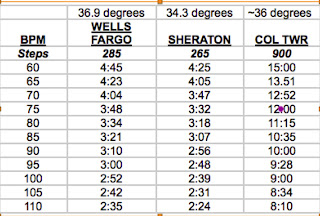
Roy Davis, retired Firefighter Combat Challenge Champion has engaged in a number of stair climb events and has created a matrix that’s helpful in creating a number of targets (i.e., number of double stairs in a set period of time). This is the same way that one would train for running a mile by calculating the splits for each quarter.
Table 1: Stair Climbing Rates
The key is that you must work within your capabilities; actually slightly below that point where you start to produce more lactate than you can turnover. Otherwise, everything comes to a screeching halt.
I noticed in Seattle that a number of firefighters had calculated the splits by floors and reduced them to a laminated “cheat sheet” much like the way quarterbacks list the plays on their wrists. Other’s had put a playlist together with a cadence consistent with their climbing objective of a specific number of steps per minute. This was done by using a metronome or a software program (Mixmeister.com) that will find songs with a cadence consistent with the targeted rate of climb.
By finding a stairway in which to practice you can rest assured that your first stair climb for record will be a success. Like any aerobic fitness event, you can expect improvements of about 1% per week. Since leg strength enters the equation with added weight, improvements might come faster.
Keep in mind that the thermal load of climbing can be significant- more than 15kcal/min, so you’ll want to dump heat by opening up your vents! Most of your heat is dissipated through your head. A helmet interferes with this process. If you’re going to be climbing for 25 minutes, heat exhaustion can complicate the effort.
A direct benefit will be the confidence that comes from knowing that if you have to do this for real, you can!
Friday, March 16, 2012
Scott Seattle Stairclimb Part 1
For the third year, we traveled to Seattle and staffed the Gear Inspection station. The ≈1500 firefighters are now well trained in NFPA 1971. Gloves had labels, footwear was compliant and everyone had their liners in. I don’t have statistics on the numbers of repeat customers, but by the time I got around to asking the question in the waining hours, it occurred to me that there were a lot of new people.
I wrote a BlogSpot last year on the practical necessity of being physically capable of carrying your body weight, bunkers, SCBA AND equipment to the floor below the fire. No matter how many stories. The time to figure out that you can’t do this is not at the fire. So, the question posed was, “Any advice?” Besides picking up one foot and putting it ahead of the other?, actually, yes.
First, let’s examine the physiology of stair climbing. There’s not a lot of magic here. Climbing under load has been a well-researched topic. The American College of Sports Medicine (ACSM) has energy-cost equations for just about every form of human activity. Climbing stairs (inclined plane) is one of the most arduous forms of ambulation- especially if you add a load. There is a horizontal component (the easy part) and then there’s the vertical (lifting) part.
The rate of climb is determined by the firefighter- not the fire. By that I mean, despite the pressing nature of the situation, you can only climb at the rate that is supported by your ability to break-down and use ATP (the basic building blocks of energy). Taking off too fast is a common problem. You pull up on the scene and see smoke or fire showing. This gives rise to an adrenergic (hormonal) response that can overpower your common sense. The object is not just to get there, but to do your job with reasonable reserve once you DO get there.
Keeping a pace that is below your Anaerobic Threshold (AT) or more precisely, the onset of blood lactate requires knowing through experience what that point is through muscle memory. Heart rate can be instructive, much like a tachometer on a car engine. But practically speaking, no one’s carrying HR monitors at the scene of a fire.
There are practical differences between racing up 69 flights of stairs and having to do this for the real deal. But the benefits of training convey to either situation. People who are highly trained can go anaerobic without serious consequences in that they can back off and recover while they’re still moving. The unfit person will come to a screeching halt and sit down, further exacerbating the situation. In other words, the well trained firefighter-athlete is a safer, more effective worker. And the more fit the individual, the greater the physical work capacity.
In my next BlogSpot on this topic, I’m going to layout a formulaic approach to training for climbing stairs. It’s not rocket science. But the principle of specificity of training applies: you get better at the stuff you do if it closely resembles the final product.
Subscribe to:
Posts (Atom)


.jpg)