Friday, March 30, 2012

Strategic Planning for World Challenge Venues

One of the difficulties that we’re trying to get out in front of is scheduling our regional, national, and World Challenge events. We’re acutely aware that for you, booking leave is a complex process and you’d like to have as much advance notice as possible. Our last appearance of the three-year stint at Myrtle Beach will start a new process of three-year rotations. In other words, rather than returning year after year to the same place, we will start a three year rotation. 

Theoretically, we’ll be able to say where we’re going to be up to 9 years in advance (3-venues, on a 3-year rotation). Right now, we’re hard at work for next year’s (2013) event and beyond! 

Similarly, we want to organize our regional events in such a way that we can say predictably where we’ll be at a given time of the year. In case you just woke up from a coma, fuel prices have lurched to new highs and we have four vehicles that each suck down a gallon of diesel fuel every five minutes. Big trucks cost big bucks. Everything is a multiple of what you’re used to seeing in your POV. It takes 15 quarts of oil for the crankcase; and so on and so forth. Insurance for class 8 chassis are stratospheric numbers. 

Zig-zagging back and forth across the country is a most inefficient way of running this circus. When we execute our new op-plan, we’ll make two circuits and head for the Nationals and World Championship. This plan is already coming together with an ability to nail down Regional events for next year (2013) and beyond. The downside is that we might not be able to accommodate your department’s 100th Year Anniversary if it comes up out of the regional rotation. 

We’re thrilled to be at Myrtle Beach and have every intention of continuing our tradition in the future. We carefully examine all the survey data and have long ago accepted the fact that with over 3000 people in attendance at World Challenge, we simply cannot satisfy everyone’s choice. 

But, we’ll be offering you some variety in the out years with the hope that no matter where we are, you’ll have a great, level playing field with bleachers stocked with cheering fans and web-casting of all the live action for everyone at home that couldn’t make it. 

At this point of the season, be advised that getting out ahead of your airfare is the best way to contain costs. Prices rarely go down the closer you are to the event. You can save up to 50% of November’s cost by purchasing your tickets in late July or August. 

We thank you for your loyalty and your feedback and look forward to seeing you on the tour this season. 

Tuesday, March 20, 2012

Stair Climbing Part 2

Roy Davis (Standing Left) at Stairclimbing Awards Ceremony

Climbing stairs for fun, competition or a working fire can be reduced to a simple linear equation where the variables are angle of attack (in degrees), number of steps and riser height. The rate of work is dependent upon your aerobic capacity. The caveat is that the principle of specificity of kicks in; meaning that fitness is specific to the activity and you need to practice, or train doing the exercise. 

Adding a shoulder load increases the energy cost proportionate to the percentage of your body weight. Climbing (lifting your body weight) is the most arduous of all physical activities. The only thing more difficult is climbing a rope using only your arms- now that hard work. 

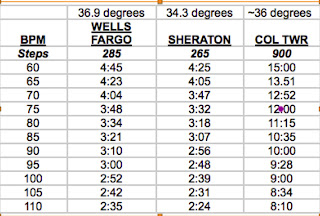
Roy Davis, retired Firefighter Combat Challenge Champion has engaged in a number of stair climb events and has created a matrix that’s helpful in creating a number of targets (i.e., number of double stairs in a set period of time). This is the same way that one would train for running a mile by calculating the splits for each quarter. 

Table 1: Stair Climbing Rates

The key is that you must work within your capabilities; actually slightly below that point where you start to produce more lactate than you can turnover. Otherwise, everything comes to a screeching halt. 

I noticed in Seattle that a number of firefighters had calculated the splits by floors and reduced them to a laminated “cheat sheet” much like the way quarterbacks list the plays on their wrists. Other’s had put a playlist together with a cadence consistent with their climbing objective of a specific number of steps per minute. This was done by using a metronome or a software program (Mixmeister.com) that will find songs with a cadence consistent with the targeted rate of climb. 

By finding a stairway in which to practice you can rest assured that your first stair climb for record will be a success. Like any aerobic fitness event, you can expect improvements of about 1% per week. Since leg strength enters the equation with added weight, improvements might come faster. 

Keep in mind that the thermal load of climbing can be significant- more than 15kcal/min, so you’ll want to dump heat by opening up your vents! Most of your heat is dissipated through your head. A helmet interferes with this process. If you’re going to be climbing for 25 minutes, heat exhaustion can complicate the effort. 

A direct benefit will be the confidence that comes from knowing that if you have to do this for real, you can!

Friday, March 16, 2012

Scott Seattle Stairclimb Part 1


For the third year, we traveled to Seattle and staffed the Gear Inspection station. The ≈1500 firefighters are now well trained in NFPA 1971. Gloves had labels, footwear was compliant and everyone had their liners in. I don’t have statistics on the numbers of repeat customers, but by the time I got around to asking the question in the waining hours, it occurred to me that there were a lot of new people. 

I wrote a BlogSpot last year on the practical necessity of being physically capable of carrying your body weight, bunkers, SCBA AND equipment to the floor below the fire. No matter how many stories. The time to figure out that you can’t do this is not at the fire. So, the question posed was, “Any advice?” Besides picking up one foot and putting it ahead of the other?, actually, yes. 

First, let’s examine the physiology of stair climbing. There’s not a lot of magic here. Climbing under load has been a well-researched topic. The American College of Sports Medicine (ACSM) has energy-cost equations for just about every form of human activity. Climbing stairs (inclined plane) is one of the most arduous forms of ambulation- especially if you add a load. There is a horizontal component (the easy part) and then there’s the vertical (lifting) part.  

The rate of climb is determined by the firefighter- not the fire. By that I mean, despite the pressing nature of the situation, you can only climb at the rate that is supported by your ability to break-down and use ATP (the basic building blocks of energy). Taking off too fast is a common problem. You pull up on the scene and see smoke or fire showing. This gives rise to an adrenergic (hormonal) response that can overpower your common sense. The object is not just to get there, but to do your job with reasonable reserve once you DO get there. 

Keeping a pace that is below your Anaerobic Threshold (AT) or more precisely, the onset of blood lactate requires knowing through experience what that point is through muscle memory. Heart rate can be instructive, much like a tachometer on a car engine. But practically speaking, no one’s carrying HR monitors at the scene of a fire. 

There are practical differences between racing up 69 flights of stairs and having to do this for the real deal. But the benefits of training convey to either situation. People who are highly trained can go anaerobic without serious consequences in that they can back off and recover while they’re still moving. The unfit person will come to a screeching halt and sit down, further exacerbating the situation. In other words, the well trained firefighter-athlete is a safer, more effective worker. And the more fit the individual, the greater the physical work capacity. 

In my next BlogSpot on this topic, I’m going to layout a formulaic approach to training for climbing stairs. It’s not rocket science. But the principle of specificity of training applies: you get better at the stuff you do if it closely resembles the final product. 


Wednesday, February 29, 2012

(Your) Back In Action

This week’s contribution is provided by long-time colleague and Biomechanic, R. Barry O’Donnell, M.S. Barry comes with some impressive credentials including being a member of the 1976 US Olympic wrestling team.

We rigorously defend our lift-drag protocol as far safer than the bent-over technique used in other settings. For this reason: safety, we’re emphatic about Challenge Competitors using proper technique. We’re very proud of our record- one of the safest sports out there.

The Biomechanics of lifting and dragging with a neutral spine and in flexion:

The strategy of lifting with the spine in flexion increases the effects of shear loading on the spine and increases the chance of injury. The fully flexed spine shows myo-electric silence in back extensor muscles and strained posterior passive tissues with high shearing forces on the lumbar spine. A neutral spine (standing tall, shoulders back lumbar curve in place) recruits the pars lumborum muscle groups to support the reaction shear and reduces total joint shear (1).  A great example of this posture is demonstrated in the CrossFit article (Brandon Cunningham, dummy rescue). As a result of lifting and dragging in this posture the extensor muscles appear to contribute to the posterior shear force that supports the anterior shear action on the upper body so that the shear forces are reduced from 1000N (Newtons ≈ 224 lb.) to 200N (approximately 50 lb.).

When lifting with the torso flexing about the hips with a neutral spine (think of the hip as a hinge) in contrast to flexion of the spine, thereby reducing the risk of injury.

The fully flexed spine is weaker than one that is moderately flexed (2).

Posture coupled with the required muscular strength and endurance is paramount when lifting and dragging to avoid injury and possible spine buckling. In addition proper training will help to decrease errors in motor patterns that may cause injury.

This is why we exercise our prerogative to intervene when we observe unsafe practices and stop Competitors from hurting themselves. 

1.   McGill, S.M. Journal of Biomechanics. 30, (5) 1997.
2.   Adams et. al. Clinical. Biomechanics. 1994 9: 5-14

Thursday, February 23, 2012

One of our Own


Tragedy can come in many forms; losing all your earthy possessions to a fire is a devastation of inordinate proportions. And the irony of being a veteran firefighter that’s seen this kind of catastrophe makes it even worse.

Chuck LeBlanc, one of the most easily recognizable figures at the Scott Firefighter Combat Challenge lost his condo this past weekend due to a defect in the insulation around the chimney in the common space. If there’s any good news, it’s that Chuck and his wife are okay. Thank God.

The next question is, “What’s the insurance company going to do?” It’s highly unlikely that they’ll make him whole. So, what can we all do? Well, I’d like to suggest donations through our non-profit First Responder Institute. One-hundred percent of monies collected will be conveyed to Chuck.

We at On Target will do everything we can to restore Chuck’s awards, prizes and premiums. Since Chuck’s career spans almost two decades, this will take some work. But, I know that there are hundreds of Challenge Competitors who will be pulling for Chuck.

The address to mail your donation is:

First Responder Institute
15312 Spencerville Court
Suite 100
Burtonsville, MD 20866
www.FirstResponder.org

You can also make a donation through our PayPal account by following the link on the home page.

Friday, February 10, 2012

Doctor My Eyes (with apologies to Jackson Browne)

For more than 45 years, I’ve been plying the highways and back country trails on an assemblage of bicycles. I first got the bug during my sophomore year while studying abroad in England. Specificity of exercise is a principle that says that training is specific to the activity. So, working on your tennis backswing isn’t going to do much for your mountain biking. However, cycling provides one of the best carry overs to skiing. And, the older I get, the more I see the need for well-rounded conditioning since I hope to ski until I'm 100, at least. 

During the winter months when a lot of people retreat indoors and hibernate, I and my compadre Dr. Carl Schneider meet daily at 5:30 and crank around our 12 mile loop that’s uphill both ways. Working out in the winter presents the challenge of keeping warm, but not to the point of heat stroke. I’ve spent a lot of time in the cold and wintered over at the Marine Corps Mountain Warfare Training Center in the Sierras. 

Windchill is a well understood phenomena. Let’s say that we could maintain a steady clip of 20 mph. Our feet are going about twice that fast. And the effect on the face causes me no small amount of eye watering. (In an upcoming BlogSpot, I’m going to talk about protecting your feet.)

Eye protection on a bike is hugely important; one of my most painful experiences is being stung on the eyelid by a wasp. I got stung once before on the lip which I thought was bad, but this sent me over the edge. In about the nanosecond that I saw it, it bounced off my face and ended up behind my glasses. Ouch! 

So, now I always wear protective lenses that wrap around my face. This is more complicated than a simple pair of sunglasses since I need a prescription to see where I’m going. Enter the Smith Optics Aegis eye protection system. You can’t put a wrap around prescription into a sunglass frame. But you can put the prescription behind the shield. Tearing is reduced to a minimum and I have interchangeable lenses for varying light conditions. 

What I like most about the Smith product is the ease with which you can swap out the lenses. Plus, the system comes with an adaptor that holds the prescription frame in place behind ski goggles. 

I know that there’s some guys like John Pennington and Steve Borski who have way more time in the saddle than I, but they have the fortune of 20/20 vision. So, if you require corrected vision and don’t want to let that get in the way of your outdoor athletic pursuits, consider the Smith Optics solution. I’m pretty sure you’ll be glad you did. 

Tuesday, January 31, 2012

If I had a Hammer


The subject of this BlogSpot is the Hammer (shot mallet) and other variables that influence your performance on the Keiser Force Machine. The Trusty-Cook hammer is the perfect tool for this job. If you attempted to strike the beam with an all-steel hammer, the recoil effect would significantly reduce your effectiveness. The head of the official hammer contains thousands of tiny BB.'s. At the point of impact, there is a one-two punch effect: the mass of the hammer head quickly followed by the shot. When the beam is hit in the “sweet spot” a distinctive ringing sound is heard. 

I’m not convinced that alternating hits from edge to edge is effective. But, I can assure you that anything other than a 90° strike is directing force in a plane that is less effective than a square hit. 

Heat is generated by the friction of the BBs hitting each other and this heat can increase to the point where the urethane will actually disintegrate. For this reason, we are only selling hammers in pairs. If you wish to purchase a single hammer, they will be available for purchase at our store. To prolong the useful life of the hammer, it’s best that it be used in temperature greater than 60°F, and not more than 100°F. And, it’s a good idea to rotate use between firefighters. 

As you no doubt know, we added heaters to the trays of the Keiser Force Machines last year. This year, we’ll be adding a hammer heater. From the survey responses, several people remarked that the heaters were not working. Yes, they were “on” for the duration. But when the temperature dipped, the hammers were no longer pliable. In my conversations with the manufacturer, I was told of roughnecks in Alaska carrying the hammer in the back of their pickup- and the shattering of a perfectly good hammer because they didn’t keep it in their cab prior to use. 

We warranty the hammer for defects, not normal use. It is not a lifetime warranty. Take care of the hammer and you’ll get reasonable use. 

Heating the trays of the Keiser has had a profound effect on creating consistency. So, the bottom line is that we cannot guarantee a laboratory-controlled pristine environment everywhere we go and every time you mount the machine. We are very much attuned to the quality control required to clean the sleds. We rely on volunteers to perform a fairly low-skilled job: spraying the tray and the runners with a 50/50 mixture of alcohol and water (to aid evaporation) and wiping the runners and tray with a clean cloth. Does this happen every time? Almost; at least 99%. 

Other than a few "short" Keisers, and hammer placements, there was only one race that I'm aware of where the competitor lost the hammer. We edited the rules to address this safety violation.